
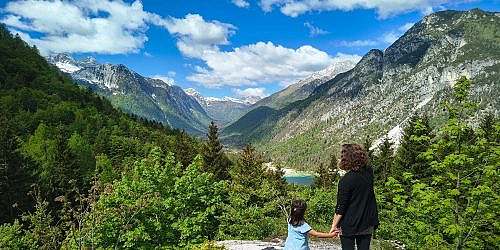
The journey to the Triglav National Park takes eight hours and small country roads over high passes to the Predil fortress from the First World War on the border between Italy and Slovenia. The lake glistens silver in the sun between the white Julian Alps. After the descent, we land at the small Toprafting camp. Colourful travellers full of stories from all over the world celebrate under the roof in the approaching downpour.
Our tent leaks on the very first night. It is bitterly cold under the thick rain clouds. I have reactivated my winter sleeping bag after my recent Fehmarn cold trauma – but Steffi only has a small summer sleeping bag. On the very first morning, we set off on a three-hour canyoning tour with a good Chilean guide. The half-hour approach to the entrance leads steeply up the mountain at first – and then steeply down into the canyon at the end.
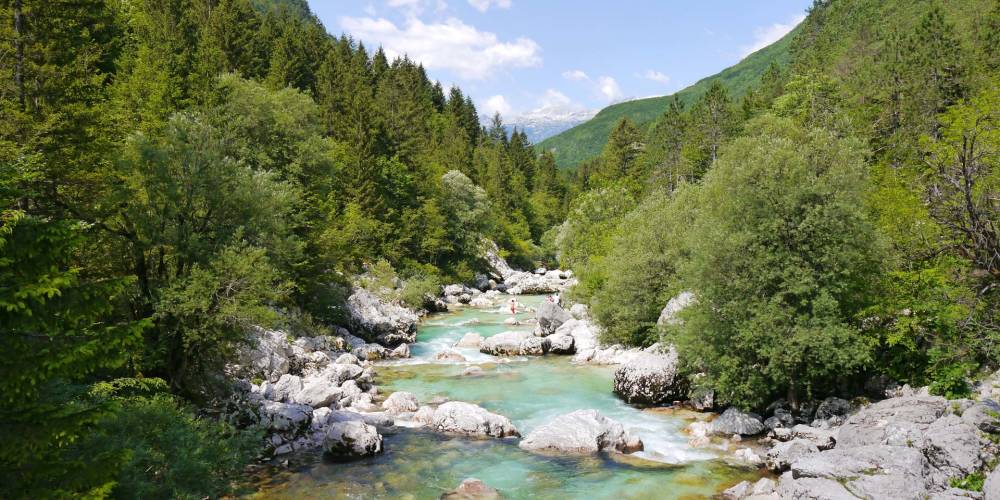
Thanks to a lot of rain, the water level is just right. We climb over rocks for two hours and swim through crystal-clear pools. In the middle, there is a four-metre slide into a small cave. The tour ends with a nice ten-metre abseil/slide into a rushing waterfall. Thanks to good seven-millimetre-thick new wetsuits and thick shoes, the frost only returns in the rain after the tour.
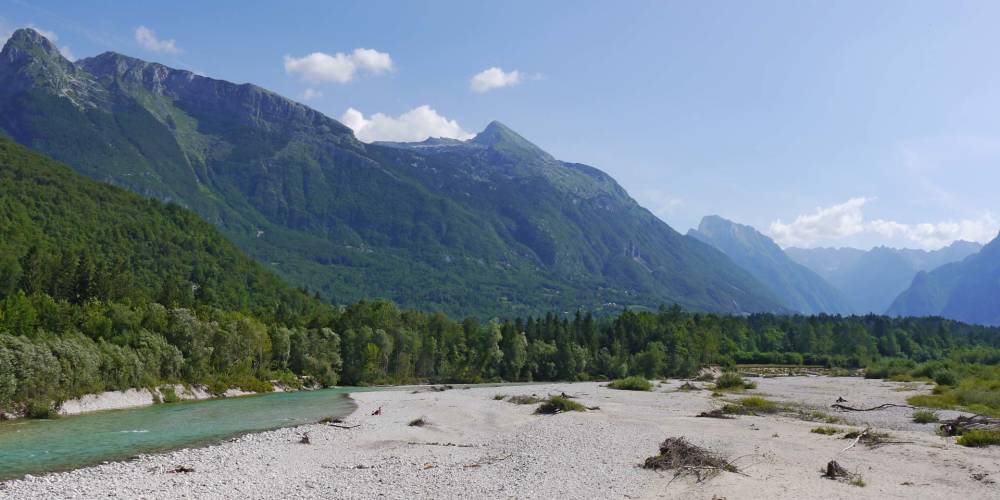
The small town of Bovec is hardly recognisable since my last visit almost 20 years ago. Everything has been renovated, many tourists flock to expensive restaurants. Slovenia is no longer a secret – but the Soca Valley still remains magical in the quiet places.
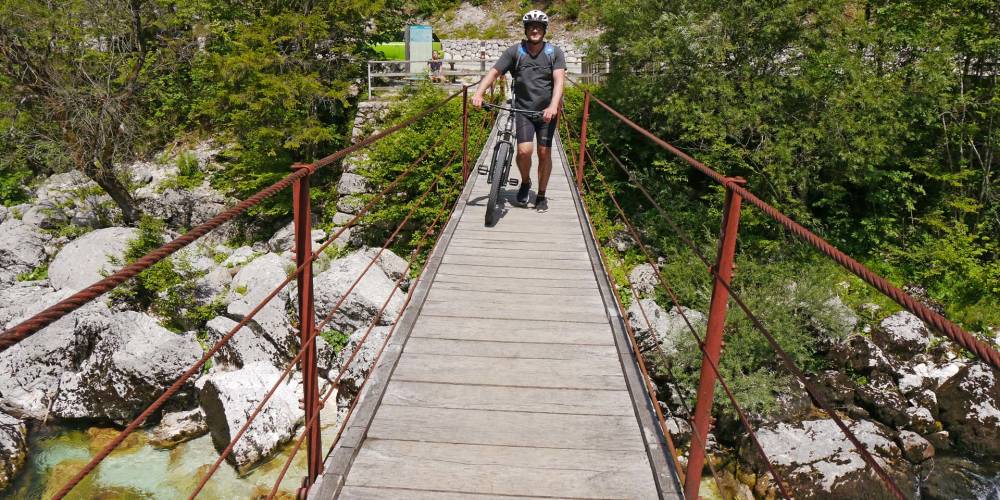
The mountain bike tour the next morning takes us along roads, gravel tracks and single trails, always close to the Soca, to Trenta at the upper end of the valley, about 25 kilometres away. The first part of the tour runs along quiet side roads and dirt tracks. The gradient is mostly moderate – but with a few detours, detours and hills along the way, we have a nice 55 km and over 500 metres of altitude on the clock by the evening.
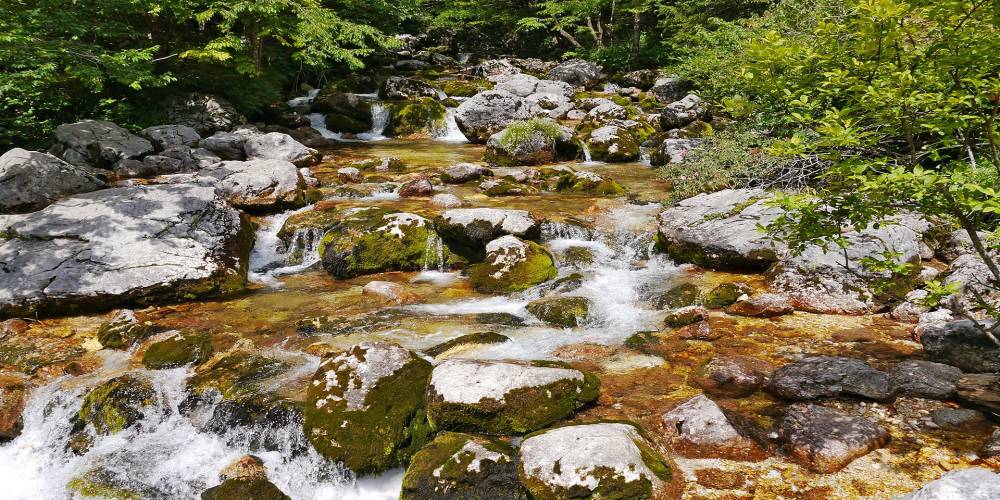
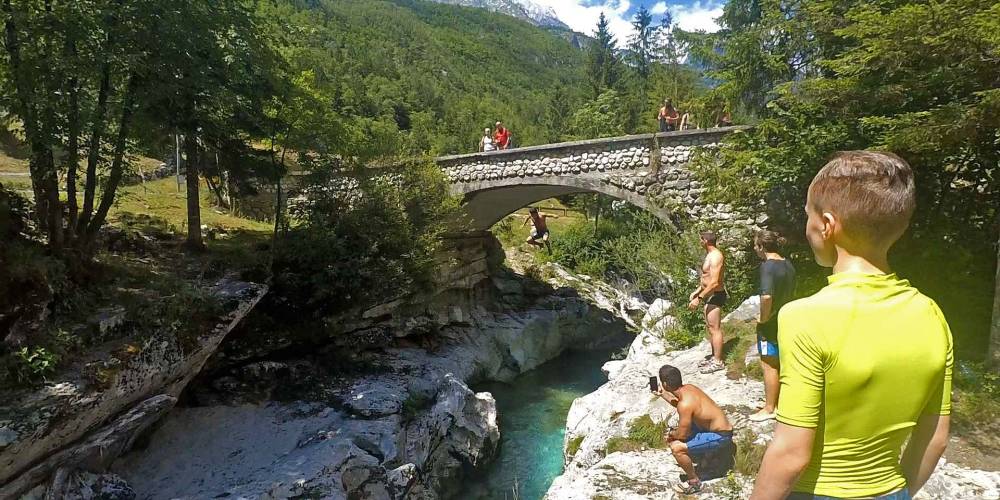
Cooling off points are just a few hundred metres apart along the way. Even in its upper reaches, the Soca is deep enough in many places for swimming or jumping from old stone bridges up to seven metres high. Even in midsummer, the water is bitterly cold at a maximum of eight degrees. Unfortunately, the only option for the upper part of the tour is the busy main road. We turn back.
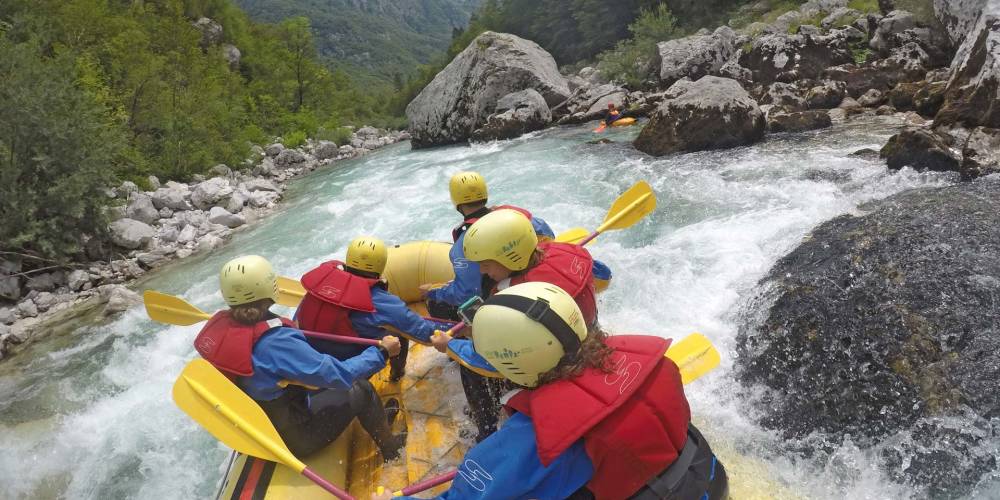
On the third day, we first raft the lower Soca southwards for an hour and a half through mild class I to II rapids. Then we drive by car up to around 1,800 metres to the Mangartsattel, which is closed due to a recent rockfall in the upper section. in 1946, the American liberators organised Slovenia’s first ski race here. Due to the steep slope at the foot of the Mangart summit, only two out of 70 participants made it to the finish line. D-Day was definitely less dangerous. Black and white sheep graze bleating on the slopes.
Today, the mighty mountains and the last snowfields shine white in short patches of sunshine between windy clouds. We climb up through the steep karst to the foot of the Mangart summit. Then the path mutates into a via ferrata. We spit briefly down to Italy and turn round again at around 2,150 metres. An Austrian ski school tortures its pupils on blades down the closed upper tarred road to heaven and glory. Further down, a mountain pasture sells very good sheep’s cheese. A lowland Slovenian successfully completes her baptism of fire on a 15% gradient with smoking brake pads and glowing discs.
On our last day in the Soca Valley, we take a short tour up the even steeper and narrower 1,600 metre-high Vrsic Pass towards Austria. Napoleon commanded his soldiers over this pass towards Russia 200 years ago. During the First World War, Russian prisoners of war extended the pass and built a material cableway, which was crucial to Slovenia’s breakthrough against Italy on the Isonzo Front. A small wooden church on the Austrian side commemorates the Russians who died during construction. There is not much to see on the pass apart from a lot of traffic. It was too noisy here for ibexes and marmots.
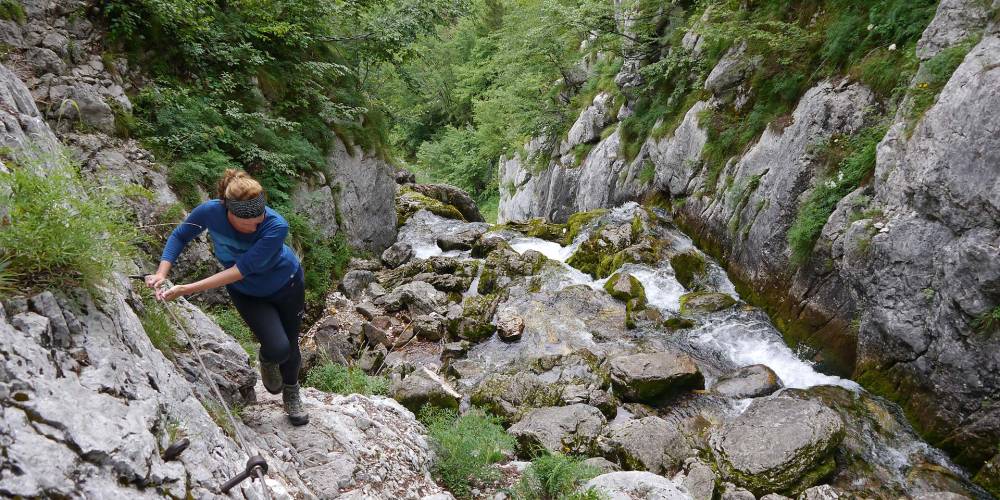
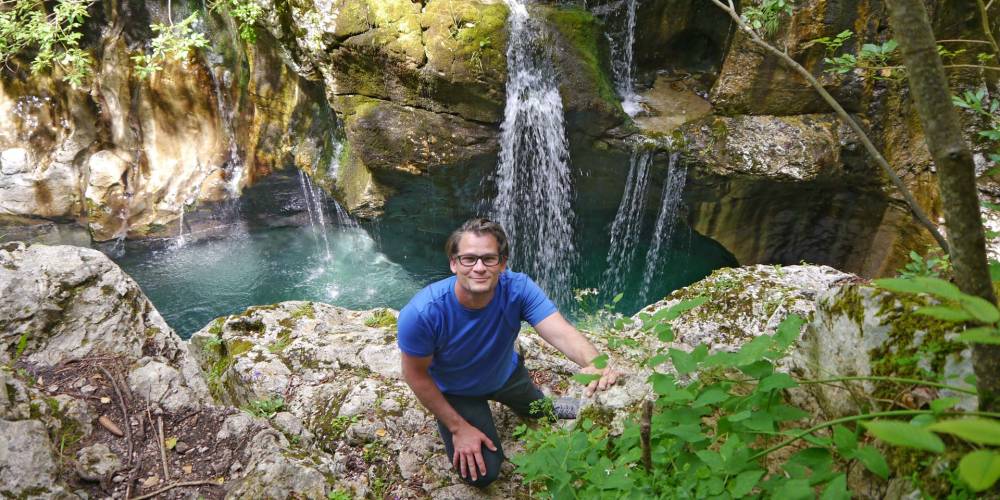
At the foot of the Vrsic Pass, the Soca emerges from a karst cave behind a short via ferrata. A sign warns of the dangers – but it is doable and definitely worth a trip because of the small waterfalls and the magical first few metres of the Soca. We set off southwards through light rain.
Our next stop is the Butik Electronic Music Festival, located on a marvellous site between the Soca and Tolminka rivers. With just 500 guests, the festival is right up my street. Kayakers make their dripping tracks through clouds of mist hanging thickly over the Soca. The powerful bass of a good sound system booms behind you. Swathes of grass settle on the gravel bed. We have smuggled in bottles of wine, which really pays off with beer and cocktail prices at Oktoberfest level.
At 30 euros for the day, I expect good DJs. Unfortunately, all but one of the DJs on the small side stage are just unused faders turning jumping jacks with dorky caps, spouting shit sound. Guy J until eight o’clock in the morning would certainly have been fine, but at two o’clock the previous sports week sends us to the mat with a vengeance. Location top, sound flop.
The next morning, the tour continues through the Slovenian Pre-Alps, small villages on incredibly steep slopes and the medieval town of Skofja Loka to the capital Ljublijana. Over the last 25 years, the town has developed into a hipster mecca with classy restaurants and lots of expensive shops. The charming old broken houses on the river promenade are almost extinct. Everything is now freshly renovated.
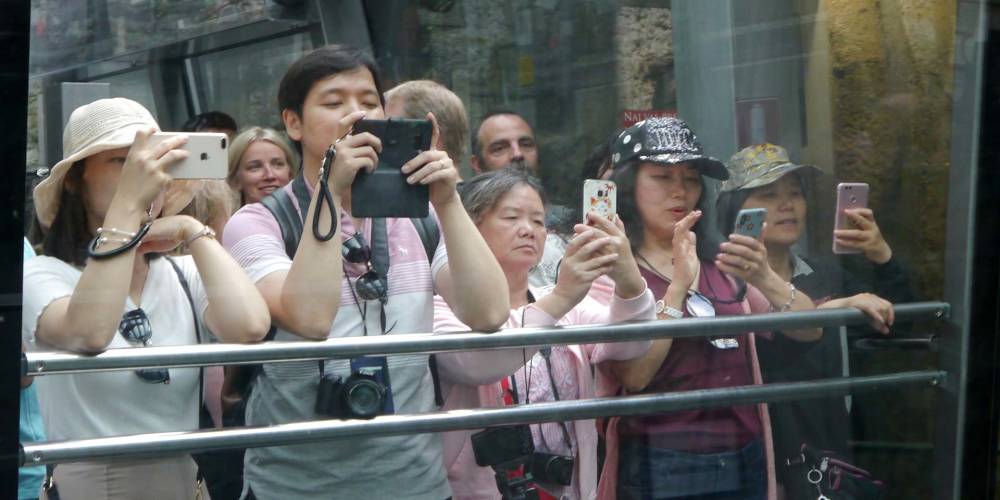
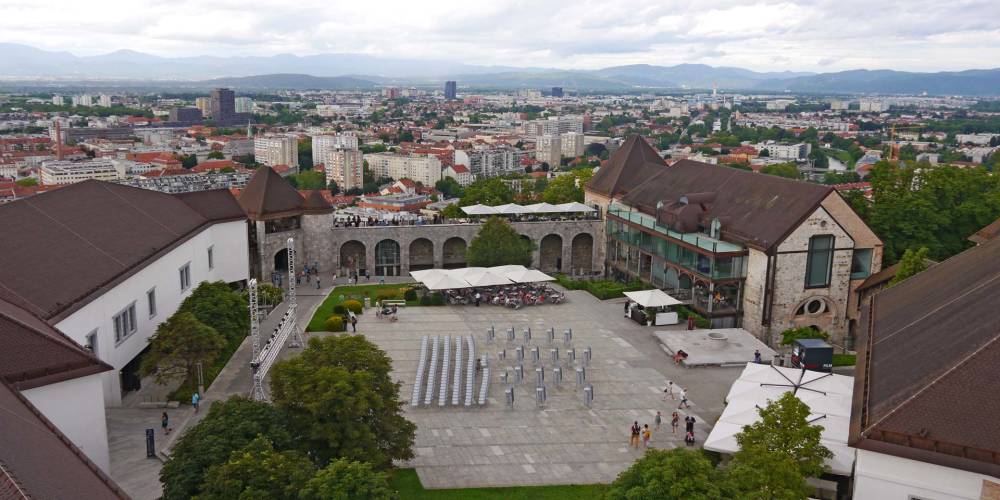
The castle with its 700 years of history has also been completely overhauled: a lot of glass and steel has been used with a lot of flair and understanding, creating really wonderful contrasts with the old walls without distorting history. There are far too many selfie-hungry, no-see-ums squeezing through the interesting exhibitions. We sneak off for dinner.
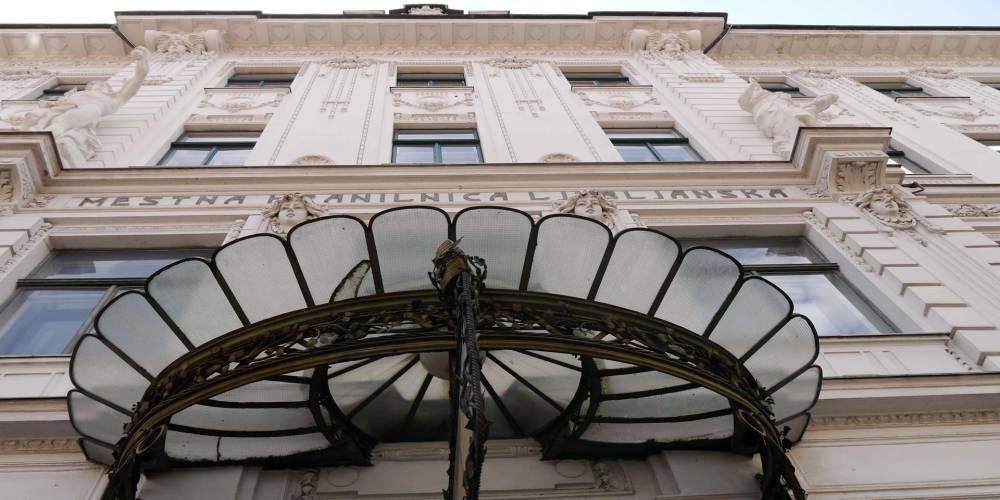
On the second day, after Tivoli Park, we join a very good guided tour of the city (Ljublijana Free Tours, Bohan). Thanks to the very funny guide, who is quick to tell quirky stories in English, time flies through the Art Nouveau neighbourhood of Ljublijana. We hop on the electric scooters that can be hired everywhere and whizz off to the alternative Christiana neighbourhood of Metelkova. Spray-painted houses, grim-faced weed chasers and punk pubs are a good change from the swank and glitz of the centre.
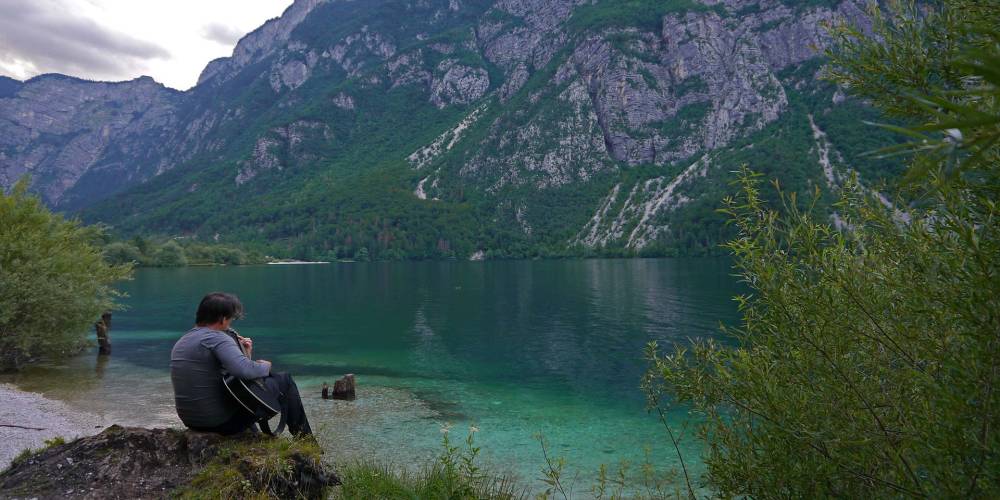
Our last stop in Slovenia is Lake Bohinj on the other side of the Triglav. As the crow flies, there are just 15 kilometres between Bovec and Bohinj. But because of the insurmountable mountains in between, the driving distance is at least 100 kilometres. Unfortunately, there are no small campsites here, only two cruel factory farms. What’s the point of buying free-range eggs and shaking your head in laughter at the difference between the camper adverts on TV and the real thing – when 750 barn eggs are the only option in a truly paradisiacal place?
We are lucky. A departing Belgian couple let us use their beachfront pitch. The ground here is less sloping than on the rest of the campsite. There, tents are pitched close together in the forest on the slope, on roots and stones that are very hard to cross. At first we grin, then the air mattress on the stones loses all its air. I feed the trout on the bank as the sun goes down. Afterwards, I play “I will survive” for them – at €27 for the right to catch “up to one fish in a day”, this is really far from ironic.
A short hike to the next waterfall only brings streams of selfie-posers rushing up 546 steps. At night, techno kids party long and loud not far from corpses snoring in the neighbouring tent. The stillness of the next morning, with fog hovering a metre above the water, saves everything. It lifts. Bob Ross couldn’t have done a better job with the mountain panorama in the misty passe-partout. We sneak away.
On the way back, we make a stopover at Lake Attersee. A small campsite is full. The others are all factory farming in cages again. Over to the Traunsee. Again factory farming or €40 for a dirty pitch right next to the busy main road by the lake. Google thinks it knows of another campsite on a farm. Nobody is there.
We ask the neighbours: “Ah, he hasn’t liked it for a year. Can you come back here? The result: the most beautiful campsite of the trip, all alone on a mountain pasture with a view of Lake Attersee and the Traunstein glowing red in the sunset. We are asked to pick berries from the garden. We thank them with plenty of wine and share properly. Crickets chirp, bees buzz and a fox steals Steffi’s socks from outside the tent in the night.
We spend the next day at the kite spot in Rindbach. The weather is not good for the necessary thermals. A horny flysufer goes on the foil in 19m² and desperately tries to get some height for an hour in the lightest of winds. That was it.
We’re out of food. Laptop is empty. Mobile phone is empty. Powerbank is empty. Batteries are full. Great journey.




 Frank Woelky, born in 1973. Kitesurfer since 1998. Since 2006, I have been combining kitesurfing and web design on trips lasting several months off the beaten track.