

The next destination is a good 1,400 kilometres and almost 24 hours by night bus south of the Atacama Desert. In cool La Serena on the Pacific, the fog hangs lower than under the Golden Gate in San Francisco. Behind it, the hot and dry Valle de Elqui rises to almost 4,800 metres to the Argentinian border. The two together create the rocket motor for Chile’s number one strong wind spot.
The Embalse Puclaro is a small reservoir in the vine-covered valley 50 kilometres behind La Serena. The wind is thermal and blows on a gigantic 300 afternoons a year with an average of 25 to 30 knots. Hidden Lines was a guest here. Vicuña is the last lively centre before the Argentinian border, 170 km away, and has a population of almost 2,500.
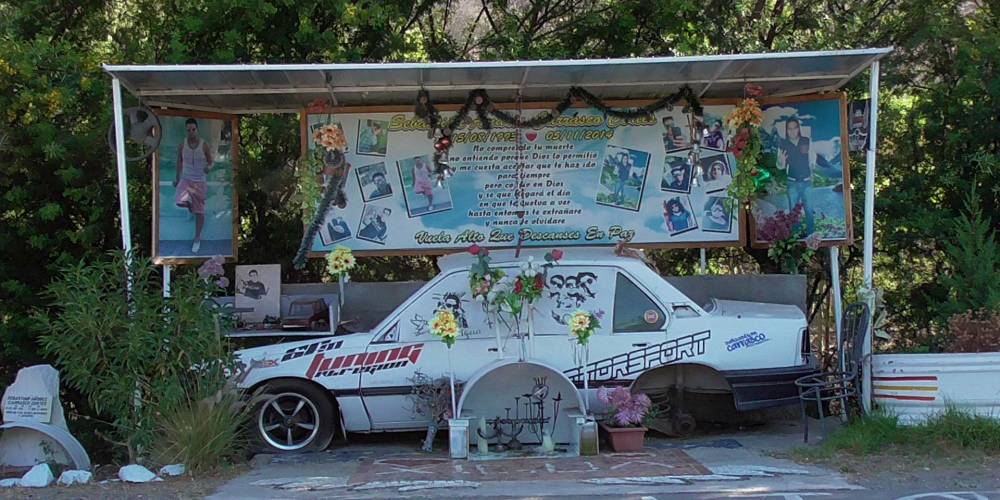
There is only one hotel right on the spot, which costs € 70 a night. After a good 9,000 km in buses, I need a hire car for the first time. I enjoy it immensely – free of butchery films, but with my own music and purposeless stops in the middle of nowhere – simply because I can. Many people die on the roads of the Valle de Elqui. On the edge of the N41, the residents build macabre tombs out of car halves garnished with plastic flowers for the mostly young and rather vocal ex-racers.
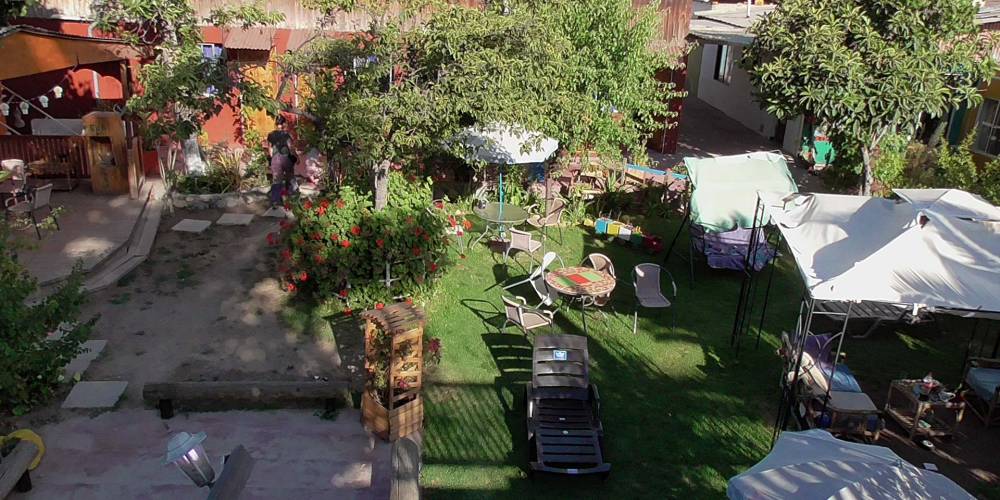
After 500 hostels worldwide, my Hostal Michel surprises me with a private dorm and a full-grown Jacuzi in the closet. The owners are real treasures, and hummingbirds buzz between prickly pears in the hippie paradise garden. The internet is fast and the workplace alone is so fantastic that I would love to spend a whole month here drinking good Chilean wine.
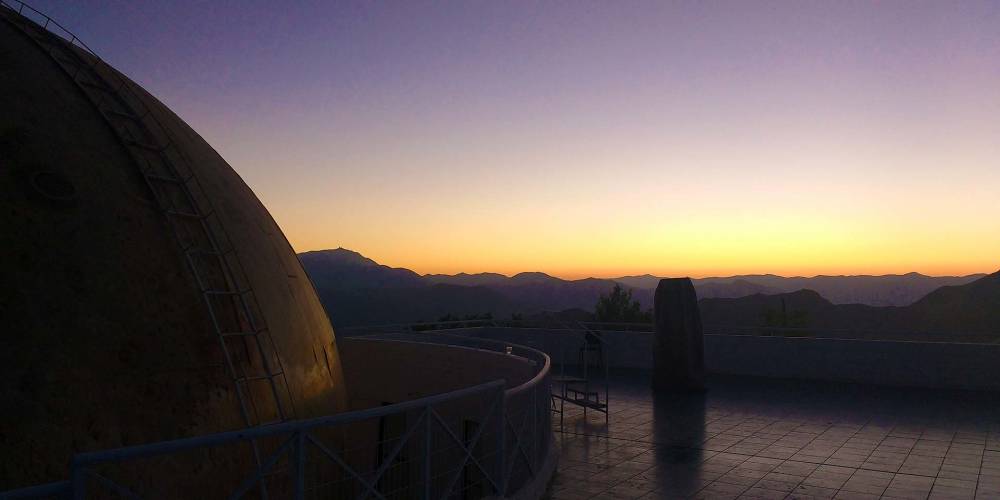
There are dozens of observatories in the immediate vicinity. I can stare at the starry sky for hours. But looking at a single one magnified in a telescope as part of a tour is somehow very boring pornography.
Many of the 20,000 inhabitants of the Valle de Elqui flock to the small town every evening to shop and chat. Life is buzzing comfortably here. The local alcoholic greets me with a friendly handshake. Then he gives me tips for a fulfilling sex life – as far as I understand him.
Compared to Ecuador, Peru and Bolivia, the Chileans here almost speak a different language. After few problems so far, I understand practically nothing here for the first time. They speak extremely fast and elide all the words so much that every sentence sounds like a single word. There is also a good pinch of local dialect in the form of vowel shifts.
In the first supermarket in two months, I realise how much I’ve missed the range on offer. To do a little shopping, I wander through its aisles for over an hour as if on extacy, blindly colliding with several other trolleys. Chileans look into my completely enraptured face and grin.
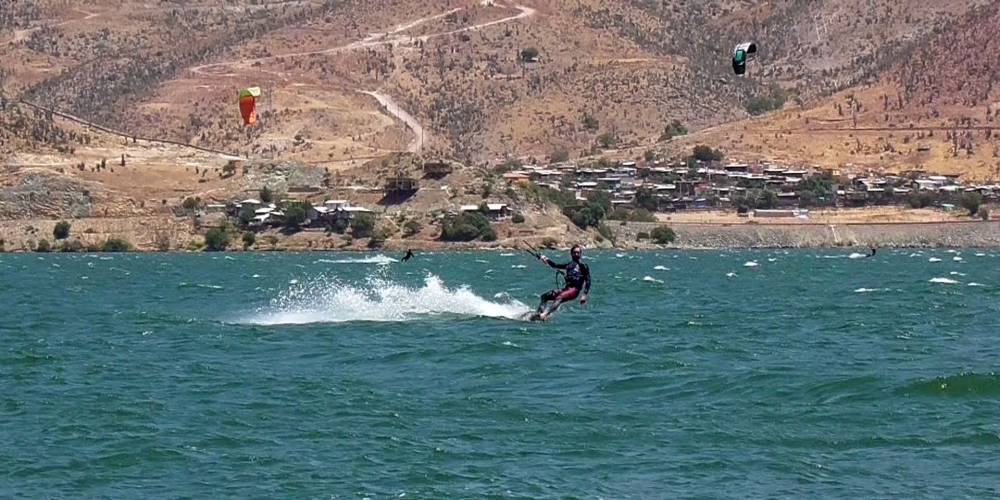
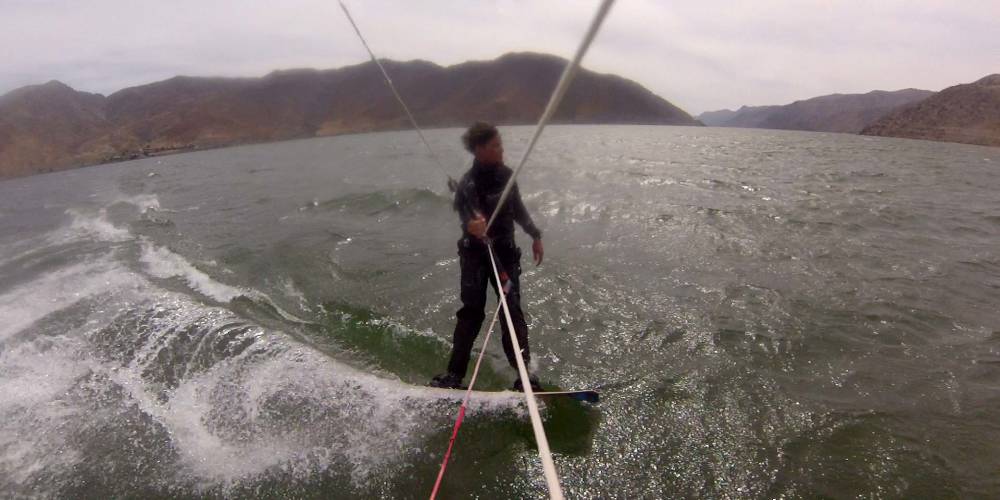
The kite spot is eleven kilometres away on the northern side of the Embalse Puclaro. There are a few small improvised schools with rental equipment as well as awnings and some plastic to set up on the hard beach – nothing else. In between, free-range goats graze. All the locals and a permanently resident Argentinian are super friendly and helpful. During my four days, there were a maximum of ten kiters on the water at any one time.
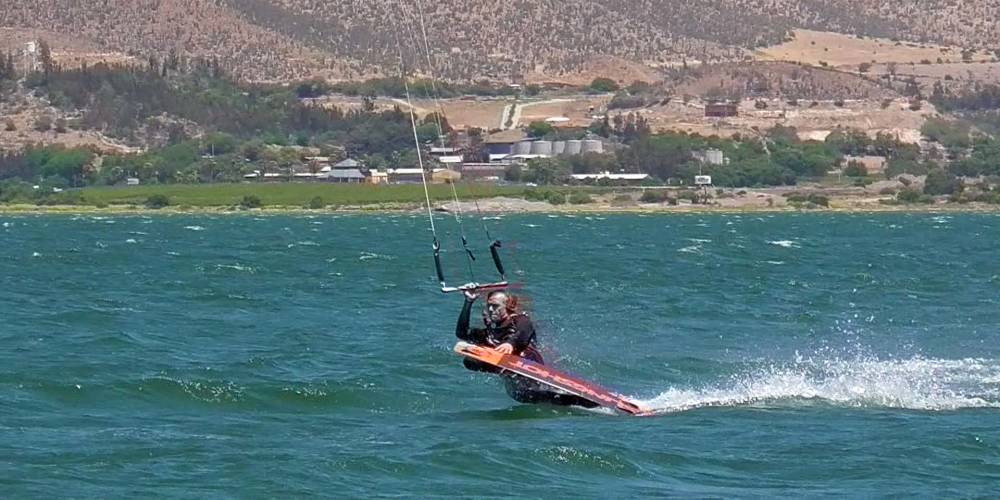
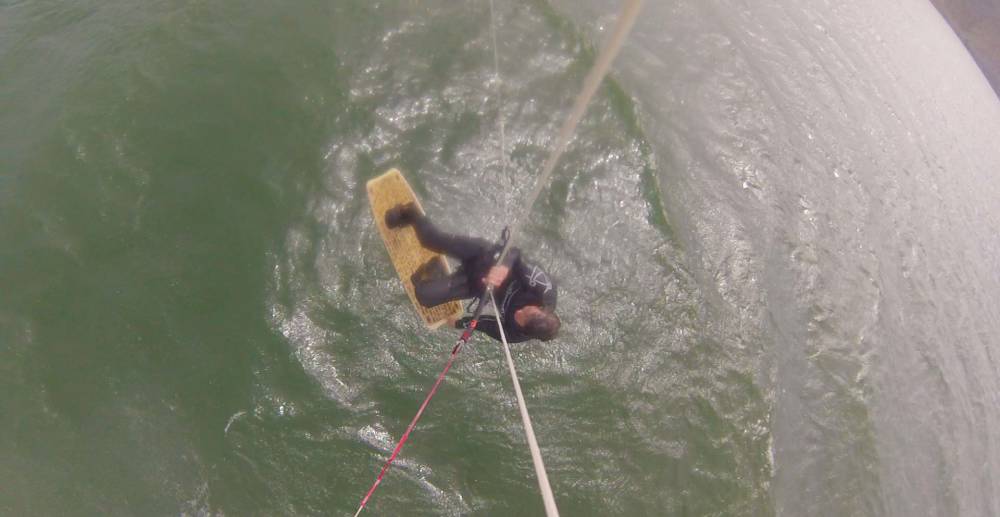
Embalse Puclaro is a real pro spot. This is evident right from the start. A mountain upwind produces quite a lot of turbulence. Even the locals, who are super capable across the board, sometimes stall a kite in the middle of the power zone. At the first start in 25 to 30 knots, my adjuster slides upwards in a gust and the 9er Rallye immediately pulls me 20 metres to windward. The only thing that helps here is to fly into the water immediately and quickly.
The standing area is zero, the entry is rocky. Nevertheless, the training continues even with over 25 bumpy knots. Once you are 50 metres out, the wind becomes more constant – and another five knots stronger. Especially close to the shore, the up to 50 cm high wind waves run in the perfect direction as kickers for gigantic big airs. Further out, the waves turn more to windward and are harder to catch.
With five metre grabs, I’m the undisputed kitesurfing nerd here. The locals mainly ride in the airspace above ten metres. As this alone is a bit too much of a turn-off in their eyes, they spice things up modestly with double kite loops on triple rotations over handle passes. A conspicuous number of them wear knee braces.
I enjoy two to three hours at full throttle every day, something the Andes between 2,500 and 4,700 metres couldn’t offer me last month: Hackwind deluxe. There was never a day with less than 20 knots. The standard is 25 to 30 knots from around one o’clock. On the third day it was choppy in places with stubborn peaks of over 35 knots, too much for safety with the nine. I wait until the wind dies down in the late afternoon.
High adventure calls one last time. The Paso De Aguas Negros is the almost 4,800 metre high border to Argentina. The first crossing with a Dane fails at the Chilean checkpoint 80 kilometres before the border. Our passes are 1,500 metres lower down in the hostel 80 km away.
Things go better the next morning. The completely lonely border guards on the edge of nowhere proudly announce that I am already the second customer today. Slowly it dawns on me why I couldn’t find a bus to the Argentinean 40 kn chop wind area of Cuesta Del Viento, just 300 kilometres away: there isn’t one.
Up to the second reservoir after another 30 km, the road is a ten-metre-wide tarred motorway, interrupted by numerous bridge construction sites. The reservoir at 3,200 metres definitely looks kiteable from the upper flat end. According to the locals from Vicuña, no one has ever been out there. Whoever deflowered the lake: Comment here please!
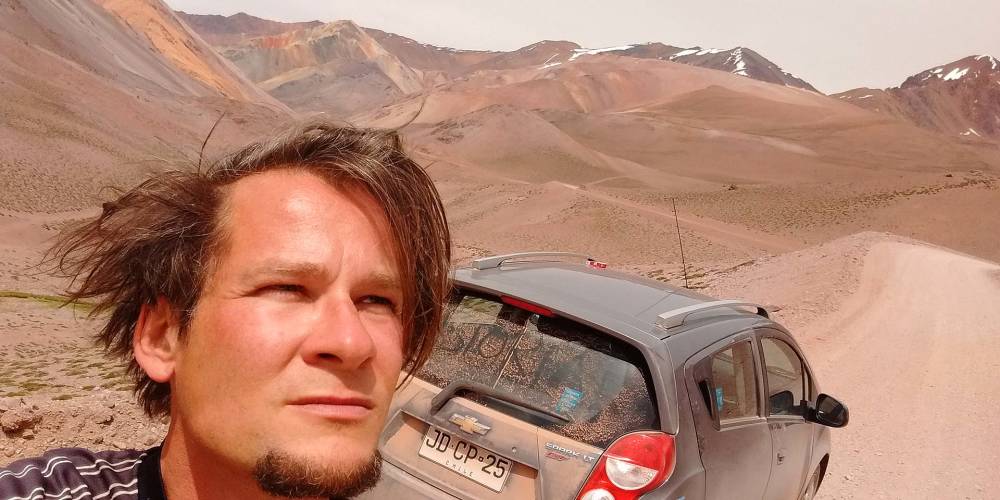
The path is now just a three metre wide gravel track without any protection to the lake right next to it. I am completely alone. Within five hours I see four cars. Mine is the only one with two-wheel drive and without at least 40 cm of ground clearance.
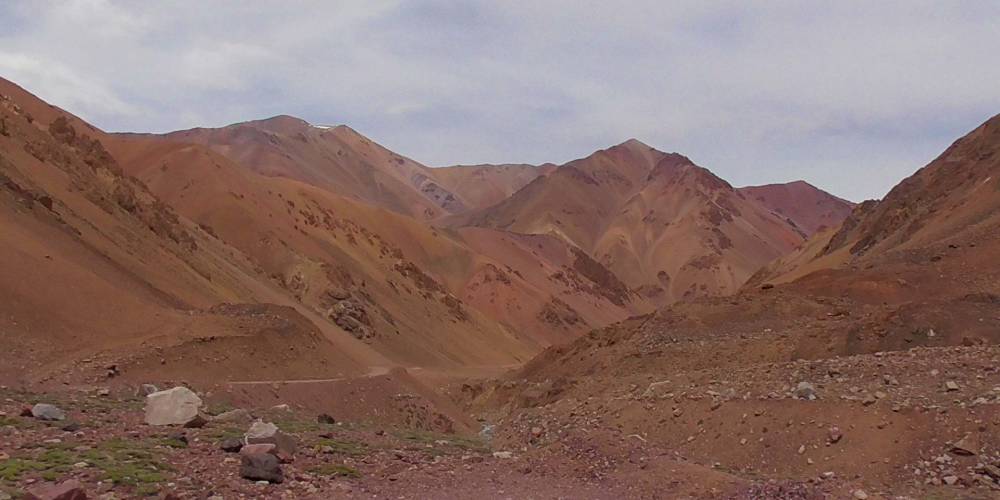
The road becomes steeper and steeper through remote lunar valleys beneath rainbow-coloured volcanoes. At 4,400 metres, the carburettor is gasping for air. Only first gear remains. It takes me another 100 metres further up to just below the eternal glaciers of the main ridge of the Andes. I still have just under 300 metres of altitude difference and ten kilometres off-road to go to the top of the pass.
I’m as far away from everything and everyone as possible with my little Spark. Even a small problem like an overheating engine would definitely be a huge problem up here. I give up, happily turn around and race down 4,000 metres of Andean rollercoaster.
The border guards completely dismantle my car and kite luggage and point out to me that there is still the possibility of a souvenir in the form of a parking ticket from the neighbouring Carabineri station.
For me, dropping off a hire car is always between picking up a report and the darkroom. First the budget woman sees the dust outside and grins with amusement. Then she opens the doors. They’re all creaking now. Mimic: Sorrow spreads. Finally, she checks the mileage and notices the layer of dust on the inside. She probably wanted to ask about the stop word. But I’m already on my way to new destinations…





 Frank Woelky, born in 1973. Kitesurfer since 1998. Since 2006, I have been combining kitesurfing and web design on trips lasting several months off the beaten track.