

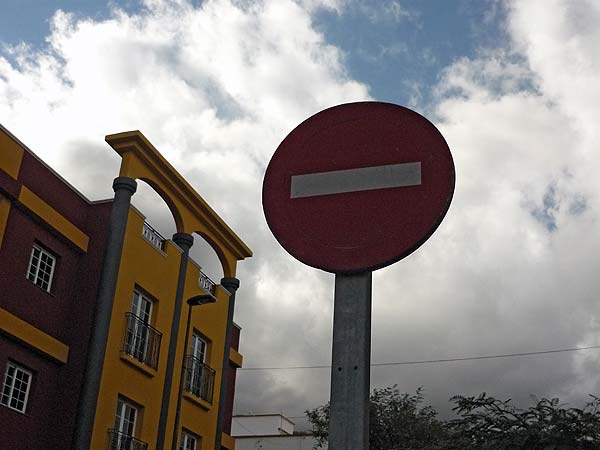
Windfinder sounds the alarm. Early in the morning, I look for a way to kite in the neighbouring village of El Medano. It’s not easy. All the roads in our empty private urbanisation are one-way streets. I end up back at the hotel seven times, with no way out. Nevertheless, I find the one-way street system symbolically very fitting.
Yesterday evening, a short walk along the beach promenade. Every waiter in every empty restaurant, without exception, is courting us. There is a shopping mall in the basement. All the shops are empty. At the end, Elvis closes his Memphis Bar. It’s eight o’clock in the evening.
Empty shops herald the low season. Empty shops say: there’s nothing to be earned here, even in the high season. Everything is too big, empty and dark. Someone has made a complete miscalculation. Why is that? A worrying theory matures in my head.
All the one-way streets here used to be open in both directions. You can still see it clearly from the arrows on the tarmac. In fact, the old directional markings are still so clearly visible that I’ve become a wrong-way driver several times. Now, however, all roads only go in one direction: into the urbanisation.
Large cities apply similar principles to traffic planning: At some times of the day, the intervals between certain traffic lights are shortened to reduce the flow of traffic in one direction. The Tenerese have drastically optimised the principle of one-way streets.
A cold shiver runs down my spine. Why did the English look so grumpy when they returned the cars? Why were there so many fewer of them than when they left? Why are all the holidaymakers here so old? And why are the hotels so empty?
We are condemned to an eternal holiday! The poor old people just can’t find their way back! They arrive here as young people. Then comes the day of the journey home. But no bus driver has ever found the way out. Every Saturday they come back a little older. I look in the mirror. Is that a new grey hair?
Despite all the transport planning tricks of the Tenerese, there are still not enough new tourists arriving to replace the ones who have died off. If I now find a hidden cemetery or a bus full of mummified corpses, I’ll be seriously worried.
The problem is not new. According to Thor Heyerdahl, the Egyptians stopped here 2000 years ago on their way to Mexico. They built a few pyramids and waited 1500 years. Then Columbus came and took them away. Some Egyptians stayed behind. They still guard the remains of the pyramids on Tenerife today. They charge a paltry €10.40 to visit the piles of stones – in the hope that one day they will be able to raise enough money for a plane ticket.

 Frank Woelky, born in 1973. Kitesurfer since 1998. Since 2006, I have been combining kitesurfing and web design on trips lasting several months off the beaten track.