

At six in the morning, we set off on the bus to Dong Ha, the last major town before the Demilitarised Zone. We want to spend a whole day visiting the former border between North and South Vietnam and some of the worst battlefields of the war. Two hours later we are in Dong Ha, 30 minutes later I have a room, breakfast, a motorbike and Jörg has his evening ticket to Hanoi.
We don’t want to travel in a group, so we treat ourselves to a private guide for $15 a day. Quang is 50 and has lived through the war. Hopes were high, but before we see the first tank he tells us stories of glorious Vietcong concubines killing GIs. That may have been the case, but he puts it all across quite comically.
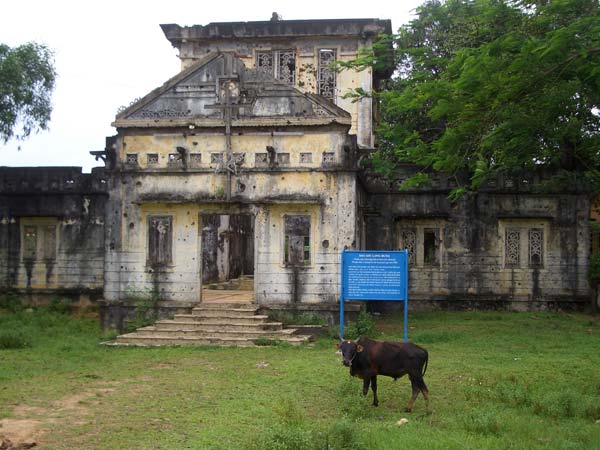
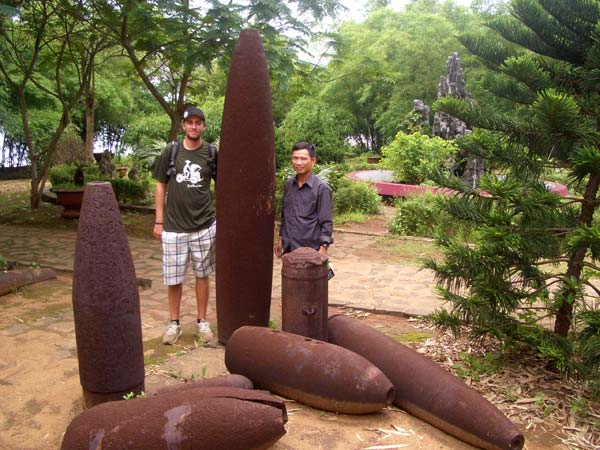
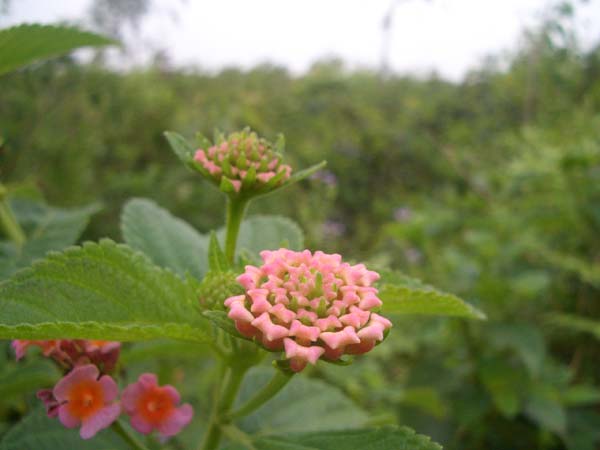
Doc Mieu was one of the American firebases behind the Demilitarised Zone. An old tank on the edge of a field full of holes. Poor people are still digging for metal here. The flowers are strikingly beautiful, the shells inconspicuously sharp.
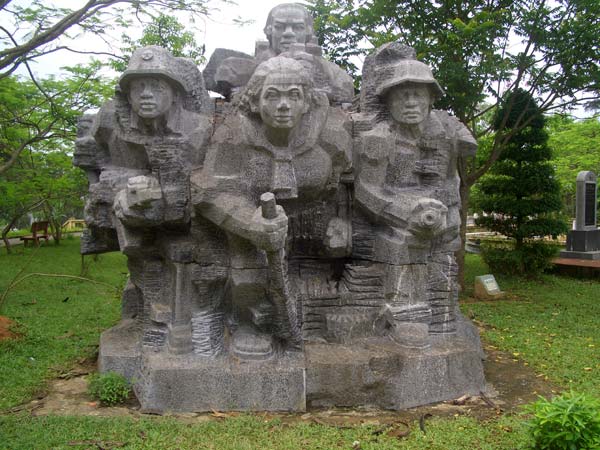
One hill further on, we look down into the demilitarised zone on both sides of Ben Hai. No area in the world has ever been more heavily armoured. The bomb craters are once again hidden under square rice fields. Even today, several hundred people die here every year from unexploded ordnance. The war memorial on the hill is quite brutalist, the stone pays homage to war rather than peace.
We ride our bikes through the valley. Was this where the girl with the burnt skin ran away from the napalm bombs? It looks like it. Water buffalo. Electricity pylons. Schoolchildren in blue uniforms wave at us. As always, the only deadly thing is the traffic.
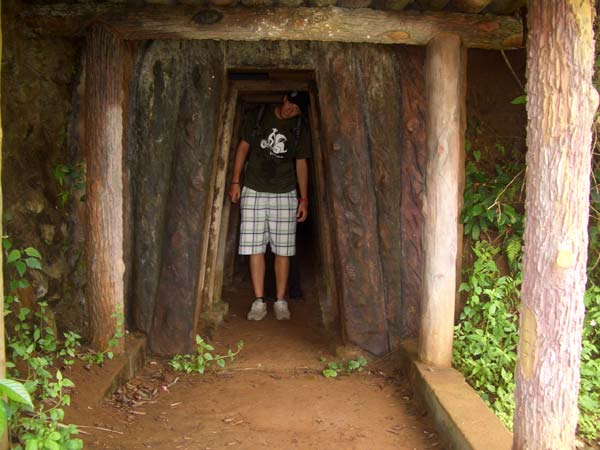
We continue along small country lanes to Vinh Moc. When the inhabitants suddenly found themselves in one of the most heavily bombed areas in the world at the end of 1968, they dug tunnels into the ground. They still exist today. Almost unchanged, a total of 2.8 kilometres run through the rock-hard red clay soil in three levels down to a depth of 23 metres.
We become tunnel rats. The air is steamy, the corridors are low. 17 children were born here in incredibly cramped conditions. In the final phase of the war, the Vietcong also used the tunnels to transport material from the beach to the interior. Back in the daylight, we see massive bomb craters.
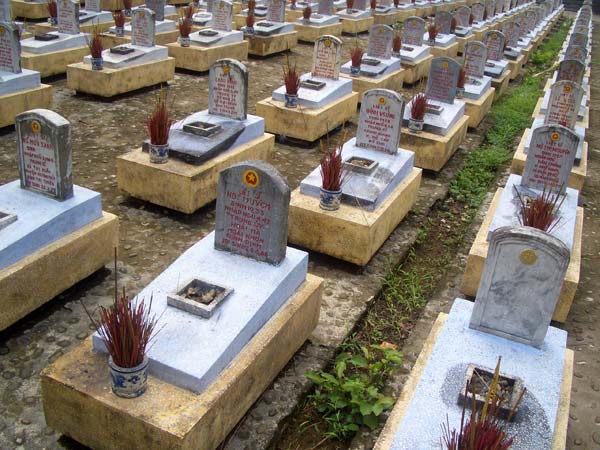
We continue 30 kilometres along small muddy and slippery dirt tracks to the national cemetery of Truong Son. Again, brutal marble figures in the centre of 25,000 dead Vietcong soldiers. Between the graves is play money, dongs and dollars. Quang doesn’t understand that I at least find the dollars rather macabre. What would the dead say if they knew they had to pay the ferryman with the enemy’s money?
A sign points to the Ho Chi Minh Trail. Under the motorway, a small stretch of tarmac leads inconspicuously southwards. Our tour together ends at Rockpile, a naval camp at the top of a steep mountain. Jörg drives back to Hong Da with Quang, not wanting to miss his bus to Hanoi. I continue on Quang’s powerful Suzuki.
After 60 kilometres I arrive on a ridge in Khe Sanh. in 1968, more than 15,000 people died here within a week in one of the bloodiest battles of the war. There is practically nothing to see. A stupid museum, two replica bunkers, a few downed helicopters. Beautiful mountains and flowers.
As the rain starts to fall, I head back down into the valley, along a river, past pile dwellings and back to Dong Ha. Quang picks me up again the next afternoon. Another cemetery, another museum, then to Quang Tri, where there was so much fighting for 90 days in 1972 that all that was left of the old town was dust. Broken. Back to Hue in a 10-seater minibus with 16 passengers and three banana trees.
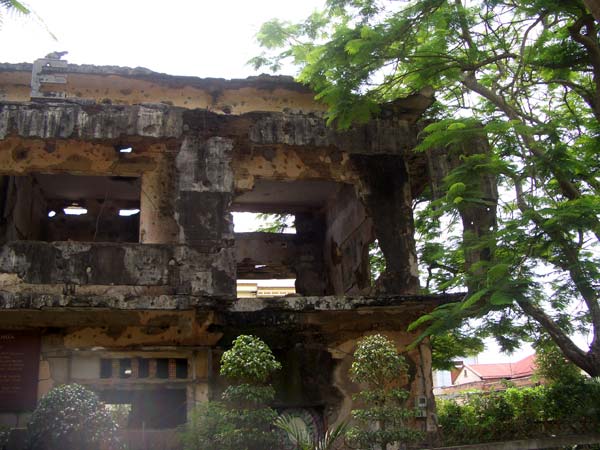
Vietnam’s history is so bloody that it had to forget it in order to live on. Everything reminiscent of the war was destroyed. Vietcong soldiers were buried, only South Vietnamese soldiers have been left to this day. Grass and flowers grow over the old battlefields.
It bothers me that Vietnam markets the war so much to tourists without there really being anything to see or hear. No pictures, no stories, stupid museums. The war stays away from me, I haven’t learnt anything. As always when I had high expectations, they were disappointed. Should have just hiked part of the Ho Chi Minh Trail.



 Frank Woelky, born in 1973. Kitesurfer since 1998. Since 2006, I have been combining kitesurfing and web design on trips lasting several months off the beaten track.