
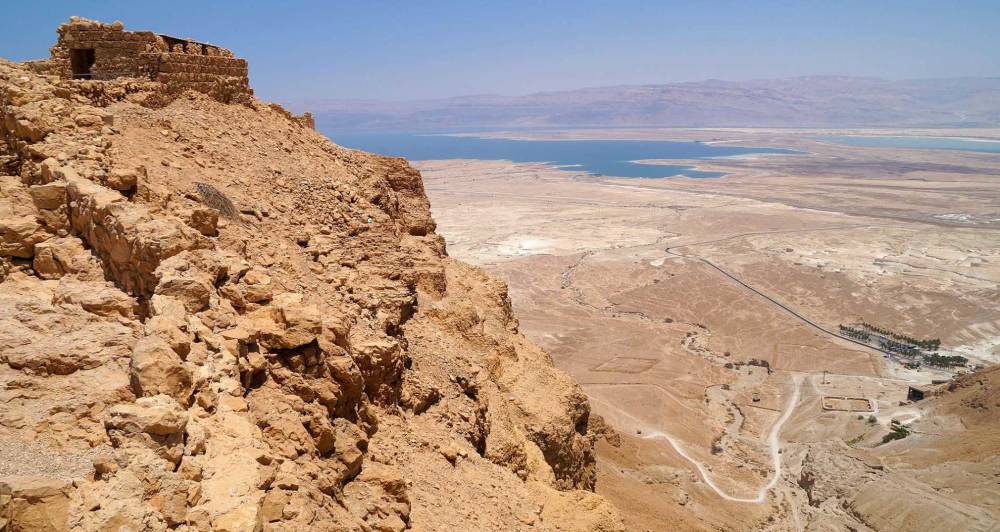
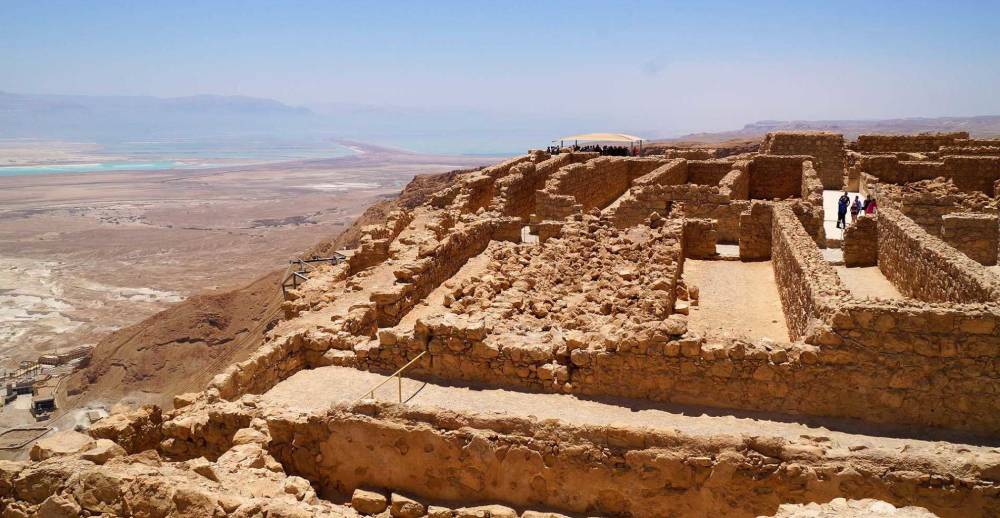
In the early morning, the journey from the Sea of Galilee continues southwards along the initially green Jordan Valley. After 50 kilometres we cross the border into the West Bank. For a long time, the road runs directly along the border with Jordan. After two and a half hours we reach our first destination. The mountain fortress of Masada lies on a 400 metre high rocky plateau at the southern end of the Dead Sea.
Built around 100 BC, Masada initially served as a winter residence for the unpopular King Herod. However, Masada became a UNESCO World Heritage Site due to the great uprising against the Romans from 66 B.C. The last 1000 rebels of Judea fled to Masada after the destruction of Jerusalem. The Romans besieged the mountain fortress for several months in the year 73.
The climate and the environment made life in the mountain fortress extremely difficult. 40.the cisterns were filled with water brought up by donkeys and filled with rainwater via canals. There were no opportunities for agriculture – all food had to be transported over long distances and stored in large larders.
As the fortress could not be captured due to its location on the steep, winding footpath, the Romans built a gigantic ramp on the western side of the fortress. On this they erected a 30 metre high siege tower with battering ram and broke through the walls. They found an empty fortress. All but three of the inhabitants had preferred to take their own lives rather than continue living under Roman rule. After the siege, Masada fell into insignificance.
Most of the walls that can be seen today have been rebuilt by archaeologists. Presumably they are trying to justify the hefty €20 entrance fee – local archaeologists would surely have their hair standing on end at such reconstructions. Otherwise, there are a few remains of mosaics, wall paintings, good views and lots of guided tour groups. Not my thing. The most interesting thing about Masada is the valley station of the cable car, which reinterprets some architectural elements of the mountain fortress quite successfully.
I continue northwards with the good missionary Paul from South Africa. The Dead Sea inspires the hire car to announce critical safety deficiencies via warning lights. Not a good place for such messages, the nearest petrol station is easily 50 km away. Israel is very introverted. Just one in four restaurants in the tourist centres offers a menu in English. Even the only instructions available in Hebrew for the hire car offer colossal scope for interpretation. An old man in a kibbutz gives the all-clear over his throat microphone: it’s just a punctured tyre. Filling up with air every few hours should get us a long way.
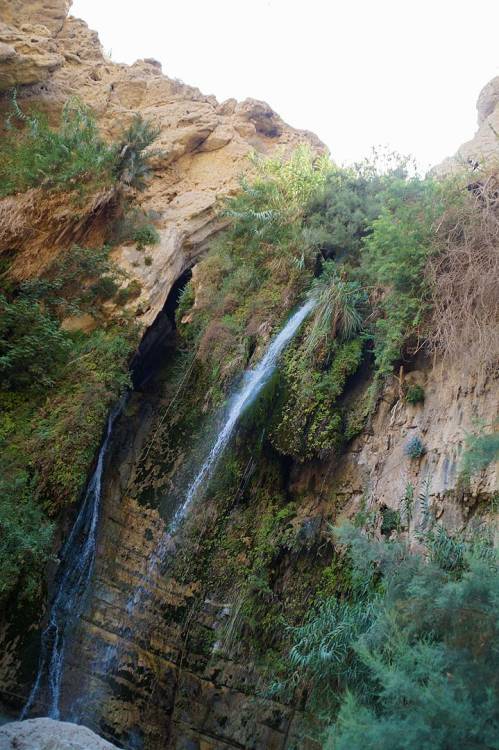
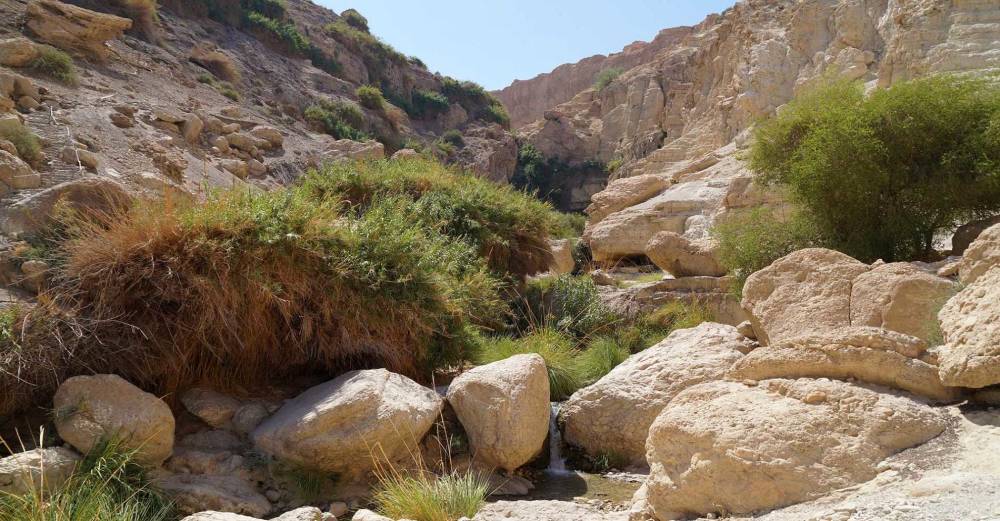
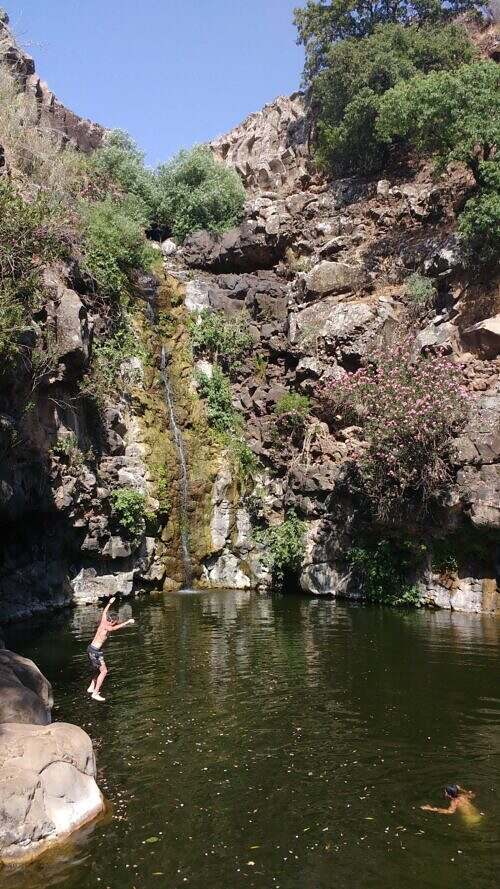
Next stop: Wadi David near En Gedi on the Dead Sea. As with every natural beauty, no matter how small, Israel also charges here. You can’t do a hike that is considered “beautiful” for less than €7. A stream runs through a narrow gorge in the foothills of the mountains over numerous waterfalls down to the Dead Sea. The sun continues to beat down at a good 40° C. Flocks of birds chirp loudly under the last large waterfall. The peace lasts until a large group of young volunteers arrives. They are everywhere here. Their purpose in life seems to be to voluntarily bring the most beautiful places in the country to their knees through acoustic terror. For me at least, it works every time.
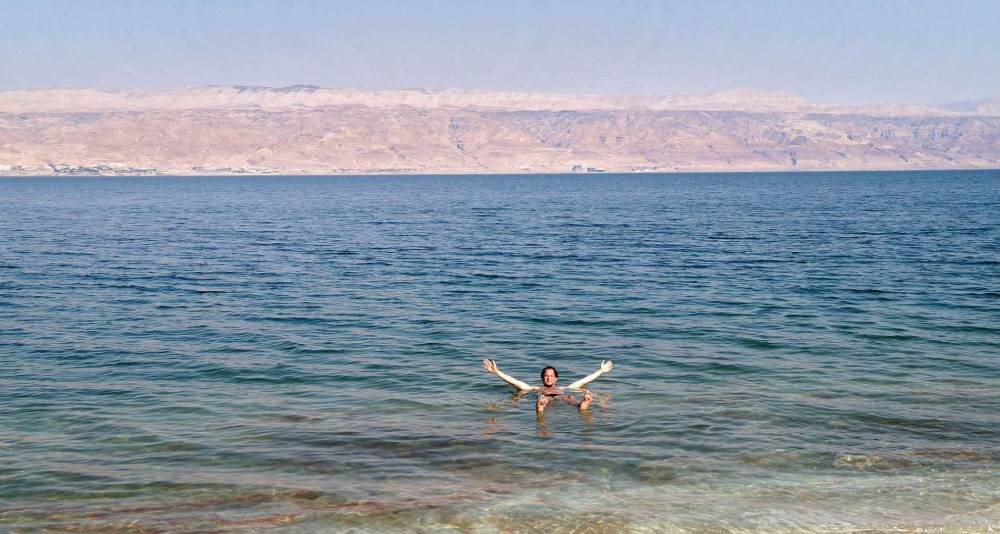
Since the Dead Sea is also considered a wonder of nature, it is not surprising that Israel strikes again. 15 € for entry to a seaside resort is too much for us. We sneak a few kilometres north along the ruins of an old hotel from the 1930s and enter the Dead Sea for free via a slope. Some things are expected. Everyone knows that you can float in the Dead Sea. Nevertheless, the feeling is surprising: even when you lift your arms and legs floating on your back, you don’t sink. On the contrary, it is difficult to get your legs back on the ground.
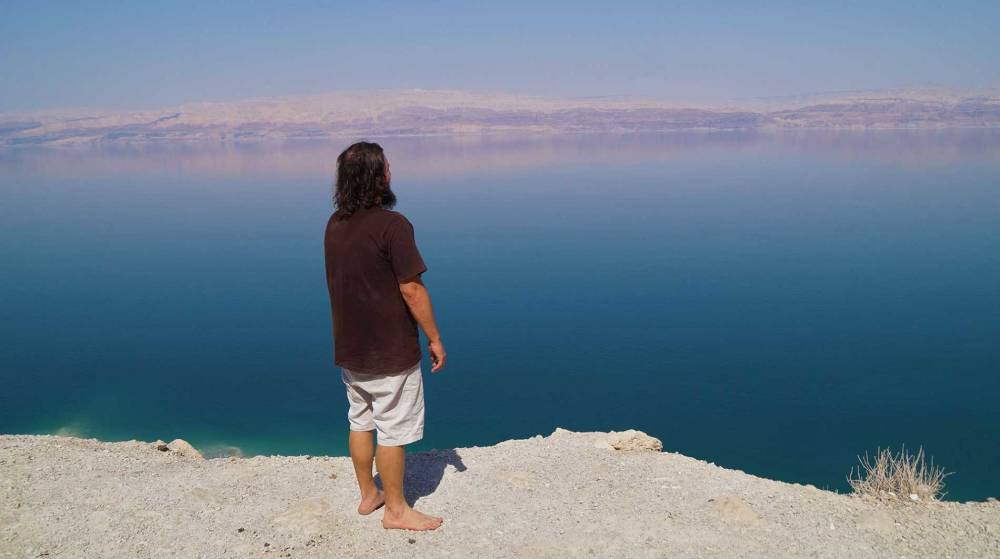
the 30 % salt content in the world’s heaviest water (1.2 kg per litre) immediately cauterises any small scratches from your last hike and burns like fire. They bleed afterwards, but are also guaranteed to be germ-free. The lowest point on earth is 450 metres below sea level. The extreme salt content is the result of an inflow without an outflow in combination with high evaporation and a 5 % increase in air pressure compared to sea level. The 40° C temperature feels heavy and humid, like a 60° sauna. The sweat is running. I shake my hand dry and wipe my eyes once. Bad idea. At least my screams don’t scare any fish until I reach the water bottle on the bank.
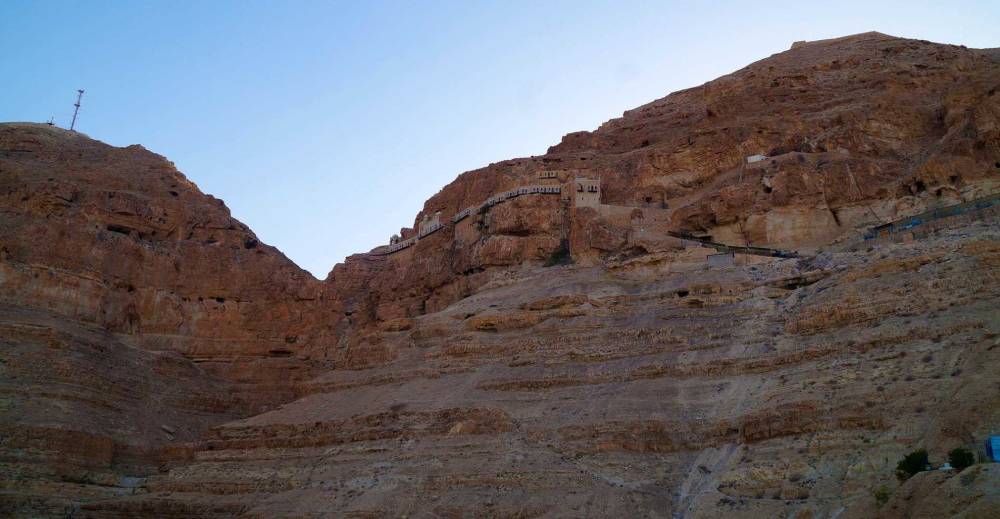
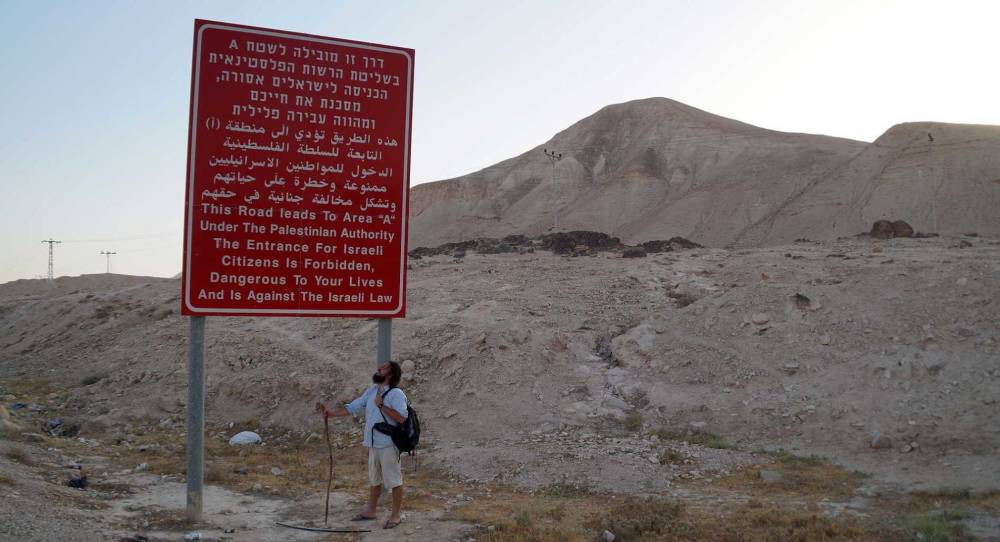
On the way back, we quickly visit Jericho, which is just round the corner. A large sign at the entrance warns: “The Entrance For Israeli Citizens Is Forbidden, Dangerous To Your Lives And Is Against Israeli Law.” So we’re allowed in? The streets are full of rubbish. Wrecked cars and half-finished houses are piled up next to it. An Orthodox monastery clings to a mountain face above Jericho. The Palestinians in Jericho give us a super friendly welcome and help us with all our needs. Parking meter? “2 shekels an hour”. Two falafel with bread and 6 salads, yoghurt and a drink? “I show you, 50 shekels”. Cigarettes and everything else are just as cheap. Compared to Israel, just 80 kilometres to the north, the prices are a welcome joke at a quarter of the cost. On the journey home, a supposed hitchhiker simply turns out to be hungry. Missionary Paul gives him all his food, even though he himself lives from hand to mouth.
On the border to Israel, Mr Supertramp realises that perhaps he hasn’t read up enough for this trip. This harbours the potential for surprises. Into the West Bank and out again requires a passport. I left it behind in Tiberias. We were waved through three times. Not on the last entry back into Israel. ID and driving licence, a brief questioning (“Where have you been? Are ou related? No, we’re brothers.”) and off home along the glowing mountain flanks of the Jordan Valley at sunset. Long, hot day…


 Frank Woelky, born in 1973. Kitesurfer since 1998. Since 2006, I have been combining kitesurfing and web design on trips lasting several months off the beaten track.