

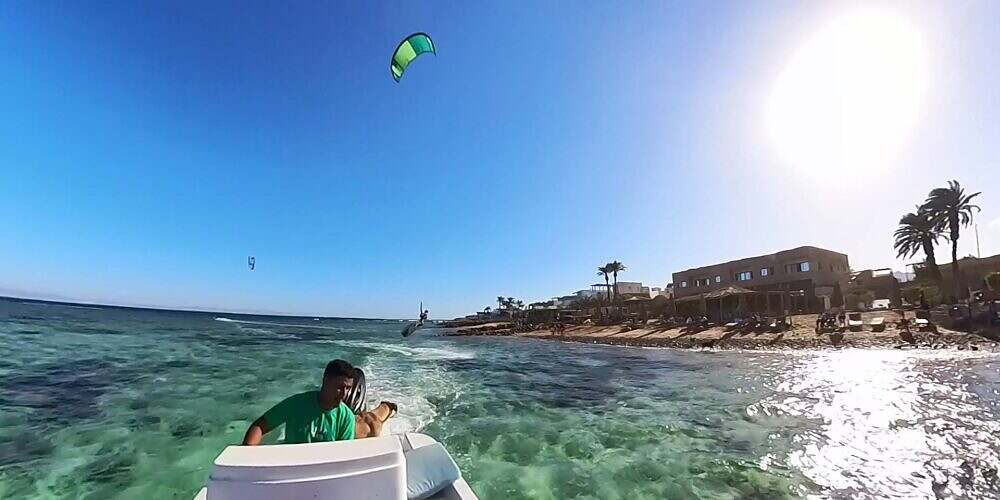
As varied as Dahab may be, I came here primarily for my religion, kitesurfing. I was enlightened in abundance. During my month here, I was on the water eighteen days a week. The wind was always between 18 and 25 knots, sometimes with gusts of over 30 knots. Five days were really calm. Seven other days were still kiteable with 15 to 18 knots. But I’ve become a real wind snob here in Dahab. Under 18 knots? Boring!
I set up the 13er Edge three times – but never used it. Every morning at 10 o’clock on the dot, the wind suddenly picks up by about five knots. After that, you can set the clock almost like on Lake Garda. As soon as the wind picked up again, it was already too much for the 13er. I spent a whole month sailing exclusively with my beloved Core XR 10m². The best forecasts were provided by Windguru, namely between the WRF3 and WRF9 models. Deviations were usually only minimal, around one to two knots.
Dahab 24/25
The best wind forecast for kitesurfing in Dahab
The forecast tends to change over the course of five days, especially when little wind is forecast. Most of the time there is still a good turn. My entire last week was supposed to be calm. Three days beforehand, the forecast got better and better. In the end, there was good wind for a whole week. The wind in Dahab blows very reliably from a northerly direction all year round – and much stronger than in the rest of the Sinai. The Gulf of Aqaba narrows above Dahab. There are bare mountains up to 2,000 metres high on both sides, and this is exactly where the wind has to pass through. Thanks to the jet effect, we usually have twice as much wind here in Dahab as in Sharm el Sheikh, just 80 kilometres to the south. The effect is intensified by the fact that Dahab protrudes slightly into the Gulf.
The best time to go kitesurfing in Dahab?
In summer, it is often 45 to 50 degrees in Dahab (Arabic for gold). This means that hardly anyone visits from June to August. The wind is also significantly less and weaker in the summer months. This is due to the strong heating of the hinterland, which creates a dynamic in the wind system that is contrary to the main wind direction. The kitesurfing season starts in September. It lasts until May. From September to December, the wind usually kicks in between nine and ten o’clock and then blows through at usually 18 to 25 knots until around 2.00 pm. After that, the heating of the hinterland again works against the main wind direction – and the wind becomes weaker and weaker on most days. Towards the end of winter, the wind blows longer and longer and can then continue at full strength until the evening in spring.
The kite lagoon of Dahab
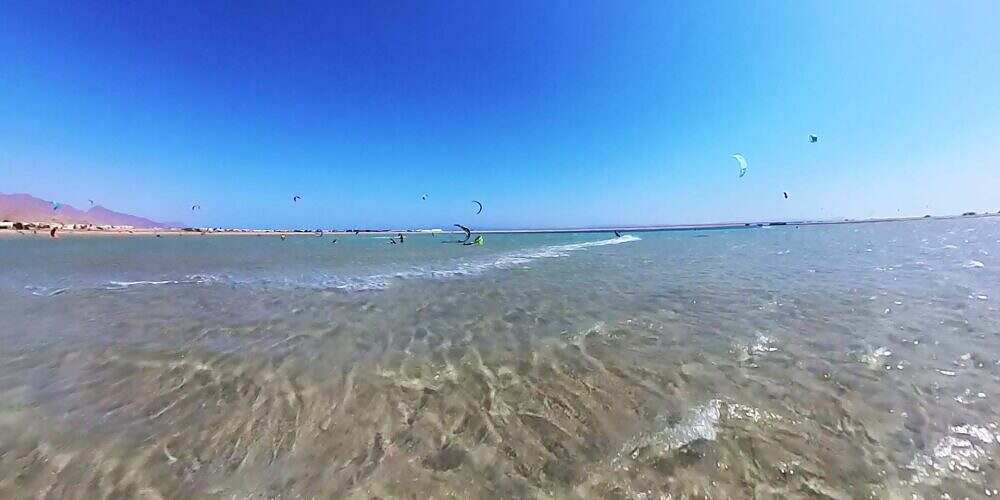
The Dahab lagoon is tide-dependent. You should therefore check the tide charts, e.g. on Windguru, before visiting. Especially at full moon and new moon, the water level in the lagoon is very low – and the space is extremely tight. Your kitesurfing trip will be best if you arrive in Dahab around eight o’clock in the morning on a day with high tide. Then you have at least ten days where the tide and wind are there at the same time. The tides in Dahab move forward by around 30 minutes per day.
Dahab’s main kite spot is under threat. Investors want to build hotels right up to the edge of the lagoon. If they go through with their plan, then that’s it for kitesurfing in the Dahab lagoon. The hotels would be located directly upwind and would therefore at least severely swirl the wind – if not kill it completely. Sign the petition against hotels in the Dahab lagoon! You can already see a clear effect of the town edge of Dahab, which is now about one and a half kilometres upwind. As long as the wind blows from the north-north-west in the morning, it can be a bit stubborn. Towards midday it turns more towards the Gulf to north-north-east and is then much more laminar.
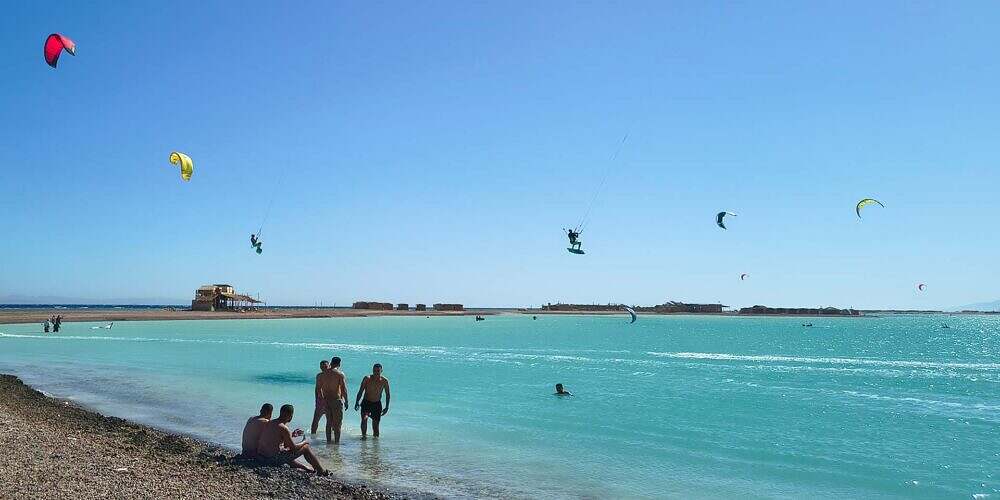
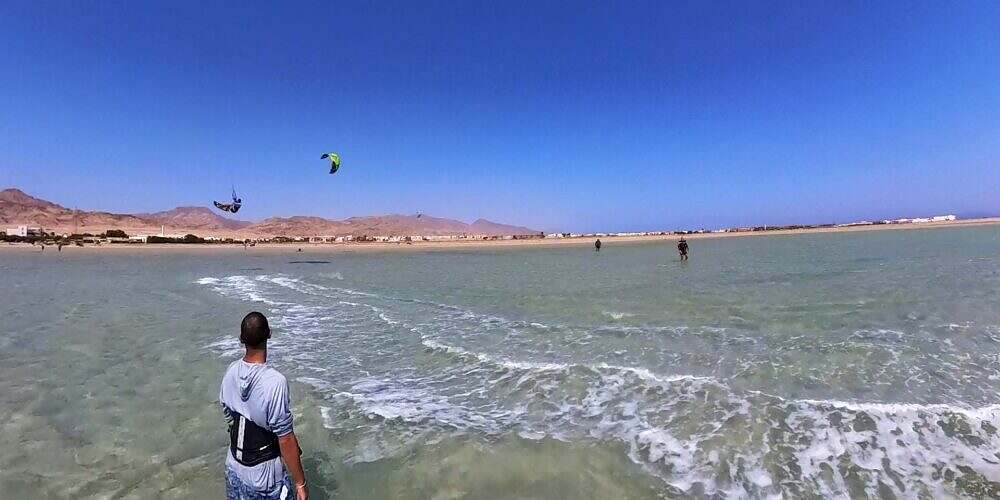
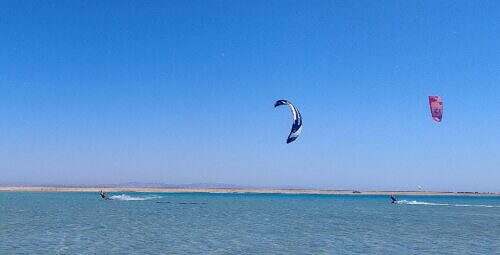
All of Dahab’s half a dozen kitesurfing schools are training in the lagoon. Especially at low tide, it can get quite crowded with up to 30 kiters. My solution? Be the first on the water. The lagoon is still empty before ten in the morning. After that and/or at high tide it gets full. All the kiters were always very considerate. Nevertheless, if you want a lot of space, you’re in the wrong place on the Dahab lagoon.
The bay to the west of the lagoon belongs to windsurfers and wingfoilers. Every now and then a kiter jumps over the sand bar or goes around the peninsula into Baby Bay. This is tolerated. Nothing more. The water in the lagoon is nice and smooth at low tide. At high tide and in strong winds, it can get a little choppy. There are hardly any dangers. In front of the Soul Kiters centre, a small area directly below the high tide line is extremely slippery. Even the Egyptian kite instructors regularly slip here. The north-east side of the lagoon is completely free of stones. From the centre towards the sandbank, there are more and more stones and a few corals. All are clearly visible in the clear water, but high jumps are safer in the north-east half – and the water is also much smoother there.
More space for kite cracks in Baby Bay
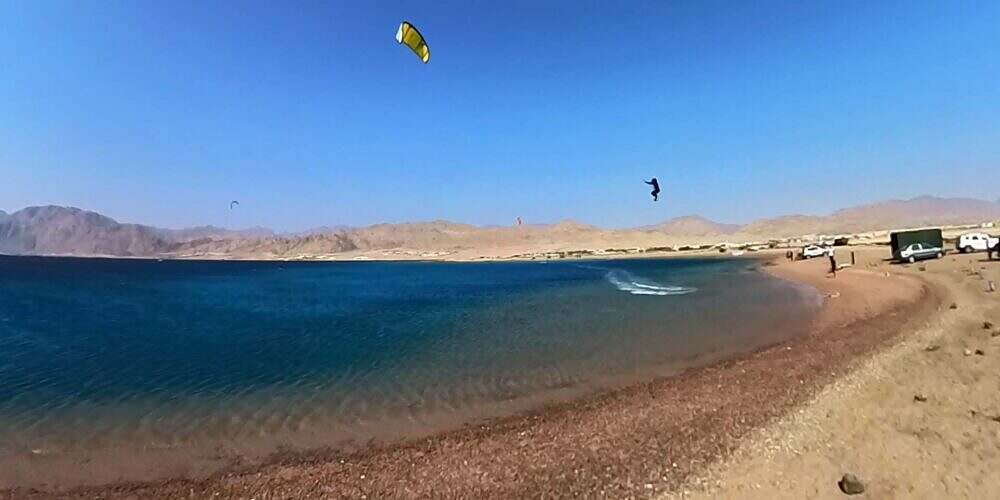
If the lagoon is no longer enough or is too narrow, you can head out to the offshore Baby Bay. You can find a detailed spot report here. The wind blows fully offshore in Baby Bay and is slightly stronger and more laminar than in the lagoon. Directly in front of the beach there is an excellent flat water launch ramp. The Egyptian kite champion Sara Sarah Sadek and a few other top kiteboarders regularly hit the hardest megaloop late backroll boardoffs here. Almost only locals and cracks ride at the top of Baby Bay. The few worse kiters who go out here stay away from the flat water ramp. The very daring also ride several kilometres out into the open Gulf towards Saudi Arabia.
The entrance to Baby Bay is only sandy in a few places. In between, there are always some very sharp-edged rocks. As soon as there are enough people out, there are usually also lifeboats. The biggest drawback of Baby Bay is the peninsula in front of it. It is quite simply a rubbish dump. All the plastic rubbish from Dahab is blown here. As if that wasn’t bad enough, there are also shards of glass all over the peninsula. I crossed it four times barefoot – but I never felt comfortable.
Kite downwinder from Asala Beach
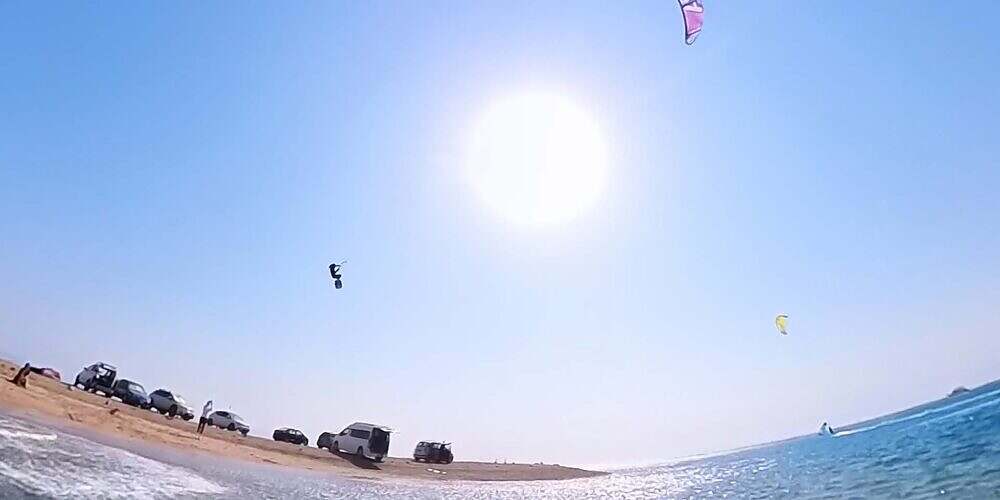
North of Dahab is the sandy Asala Beach. Here, too, you can take off with a kite or tackle a downwinder to the Dahab lagoon, six kilometres downwind. I only saw a few very capable locals at this spot during my entire month here. The reef is only centimetres below the water in places. A few anchored boats make the high jumps of the locals even more exciting.
The kitespot of your dreams: Blue Lagoon Dahab
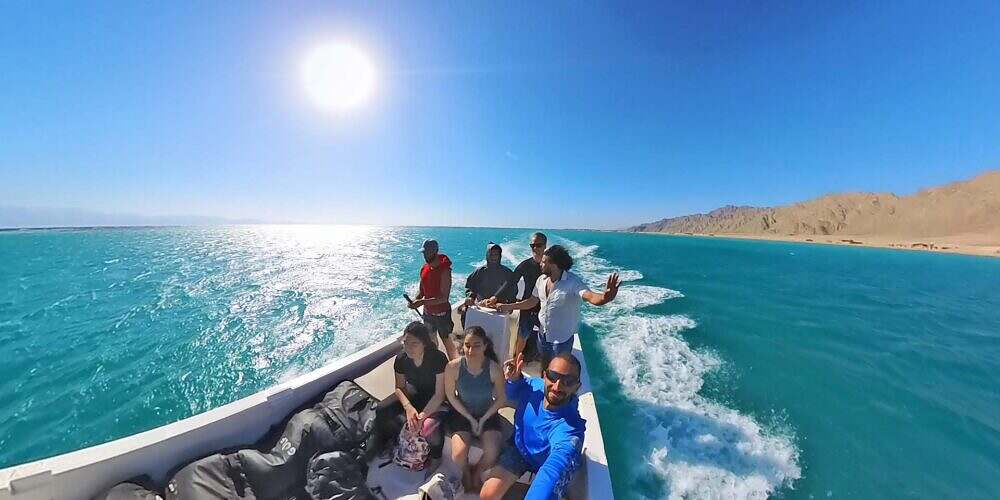
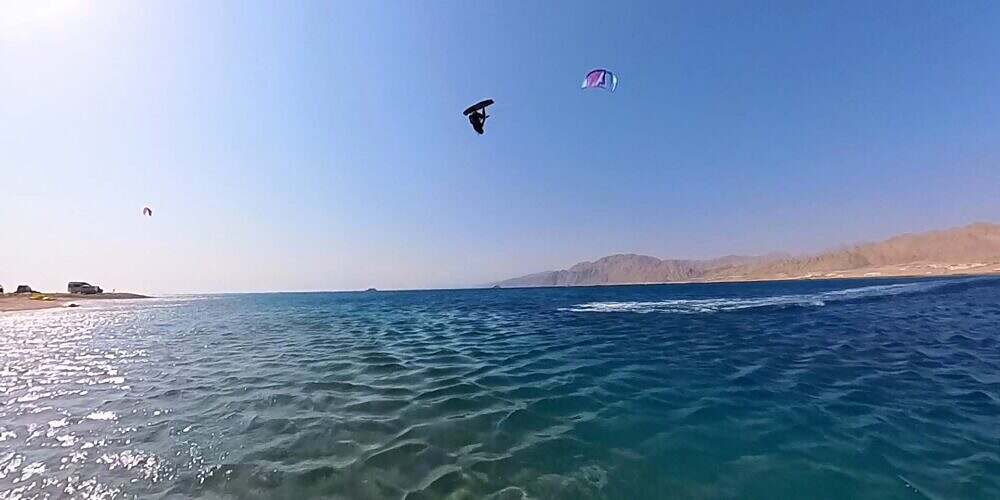
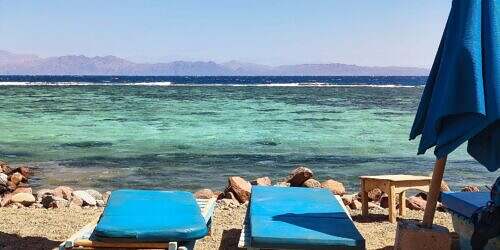
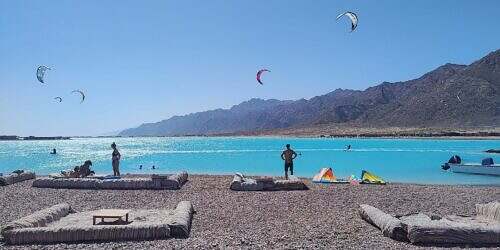
Dahab’s dream kite spot is the Blue Lagoon. Nowhere else in Egypt does the wind blow stronger. The Blue Lagoon is located exactly at the narrowest point of the Gulf of Aqaba. You can find a longer report of my last visit there here. The only way to get there is by boat across almost 20 kilometres of open sea. The swell can be quite heavy, especially on days with strong winds. With my kite buddy Youssef and his guide Shoukr, I get a very favourable opportunity to take a private boat directly into the lagoon. “Normal” tourists usually take one of the public boats that depart from Daniela Beach Resort. The public boats only go as far as Abu Golum. From there, pick-up trucks take another quarter of an hour to the Blue Lagoon.
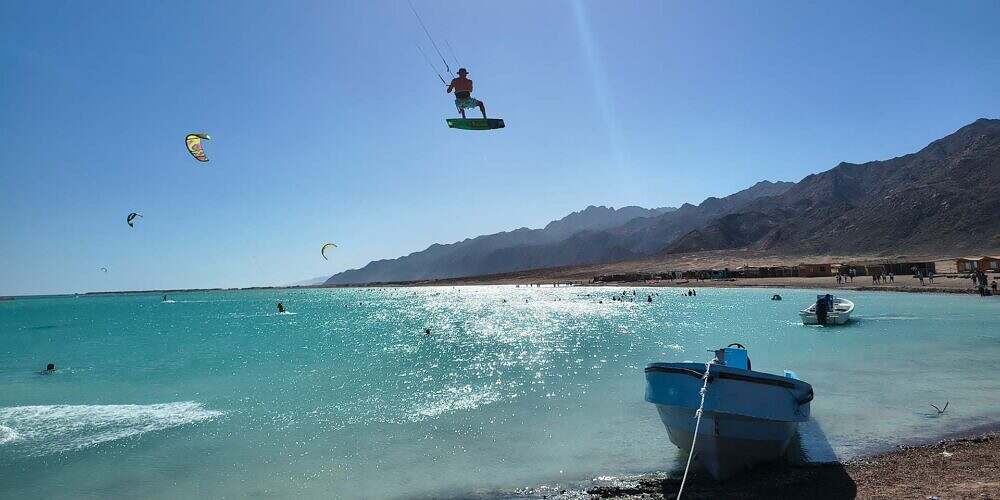
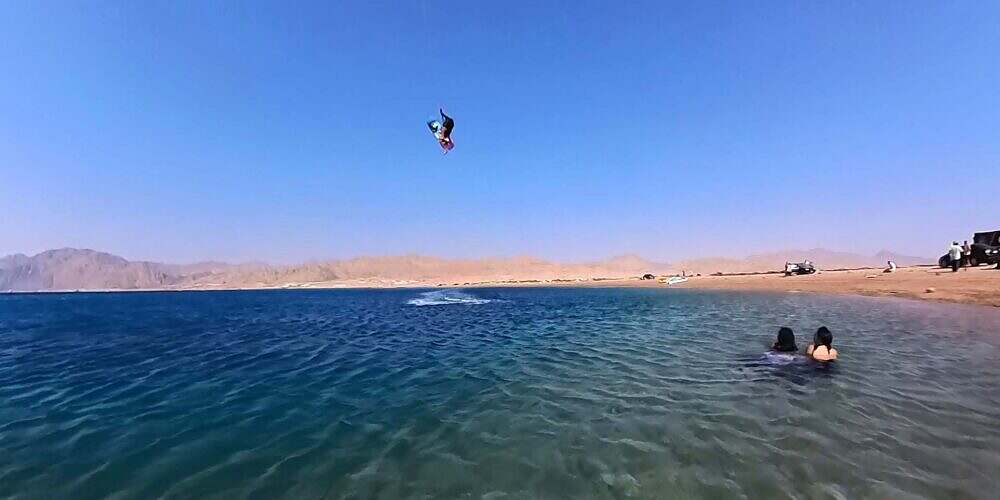
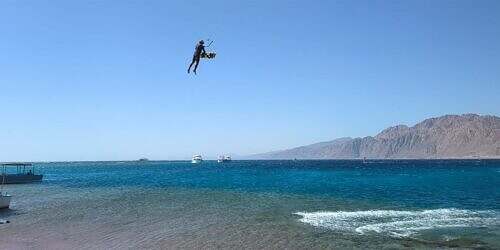
As last time, our visit to the Blue Lagoon brings us an endless number of big airs. The kitesurfers here are churning out huge hits – and sometimes land directly between Egyptians bathing in the water. Nobody has a problem with it. The flat water piste at the northern end is unfortunately very busy today, especially as some schools are still giving lessons here. You can also stay overnight at the Blue Lagoon. The cost of a simple hut with two meals is currently around 18 euros per person. Water costs five times more than in Dahab. Launching at the northern end is dangerous. The space is very narrow and the huts create additional turbulence in the wind, which usually blows at five knots more than in Dahab. Buddy Youssef drifts off quite far and cuts his foot on a stone on the way out. We kite for too long. On the return journey, our boat touches down several times on the reef in the now too low water.
Where do Dahab’s visitors come from? How do I get there?
Dahab’s tourists, most of whom come from Cairo, only arrive in Dahab from September onwards. Unlike in all the Disneylands on the Red Sea, we foreigners are really in the minority here. Life is real, sometimes very dirty – but always endearing. Never before on a trip have I heard so many interesting stories and had so many interesting discussions. Dahab was like a thousand and one nights for a whole month. I will miss my friends here. My reliable and cheap taxi driver Mohammed Sorour(WhatsApp 00201112527375) takes me back to Sharm el Sheikh airport, a good hour away, at one o’clock at night.
A month of kitesurfing in Dahab
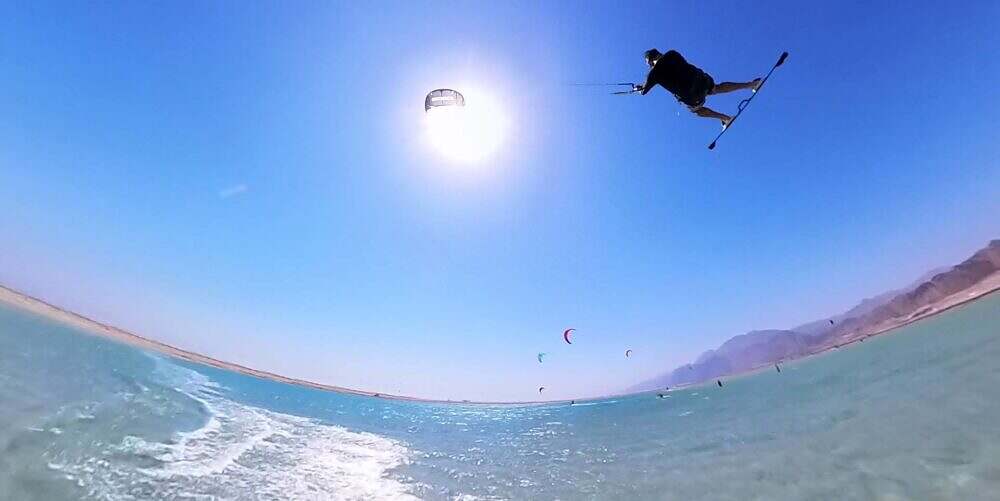
A month of kitesurfing in Dahab comes to an end. In numbers: I travelled around 300 km on my MTB. With the kiteboard almost 650 kilometres. Every single day I jumped at least five metres – and none more than nine. In total, I jumped almost 3,000 metres and flew over 18.5 km, according to the Surfr app.
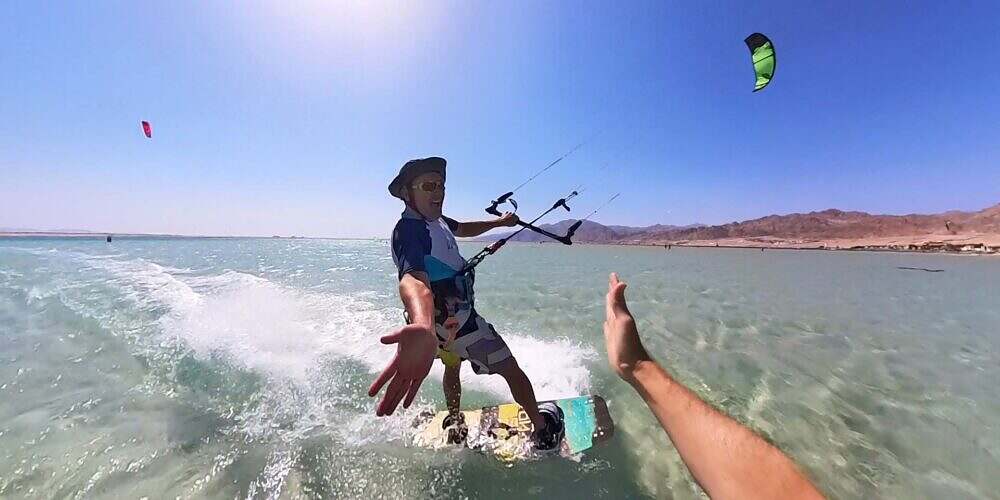
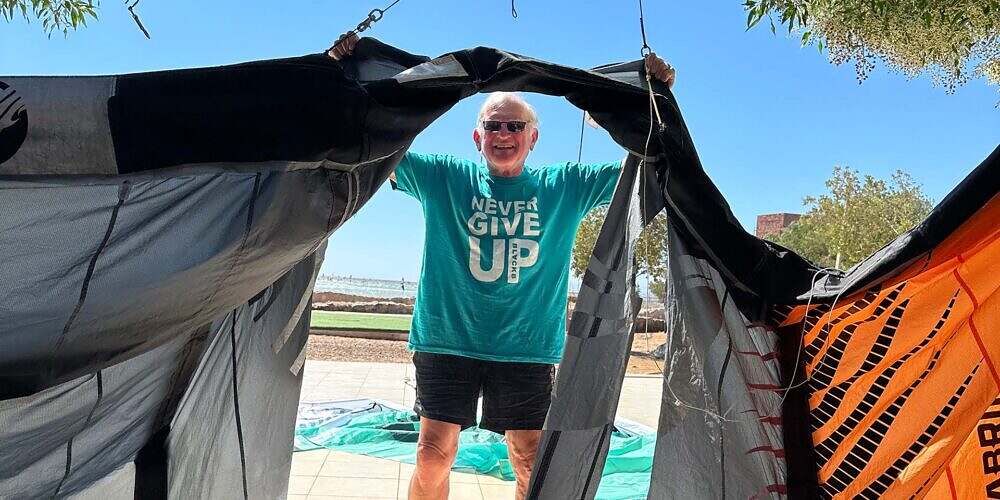
At the end of this trip, I’ve been kiting for almost half my life. I haven’t set any new records. Getting old means being satisfied with what you can still do after 27 years of kitesurfing. Hey, what 52-year-old jumps nine metres and then goes down the stairs forwards? I will reach the “Don Dodeci” one day. I was really impressed by 74-year-old Brit Andy. He was struggling with his kite course in Dahab. But he stuck with it. His T-shirt read “Never give up”. His proud grin through a torn kite lingers in my mind for a long time.
Costs for kitesurfing in Dahab?
the flight to Dahab cost €290 including regular luggage. i paid €260 for a month in a dorm with a good breakfast at the Rafiki Oasis. I paid €90 for storage at Soul Kiters. Food, drinks and everything else cost €460. It’s nice to see how well you can travel for a month on just €1,100.
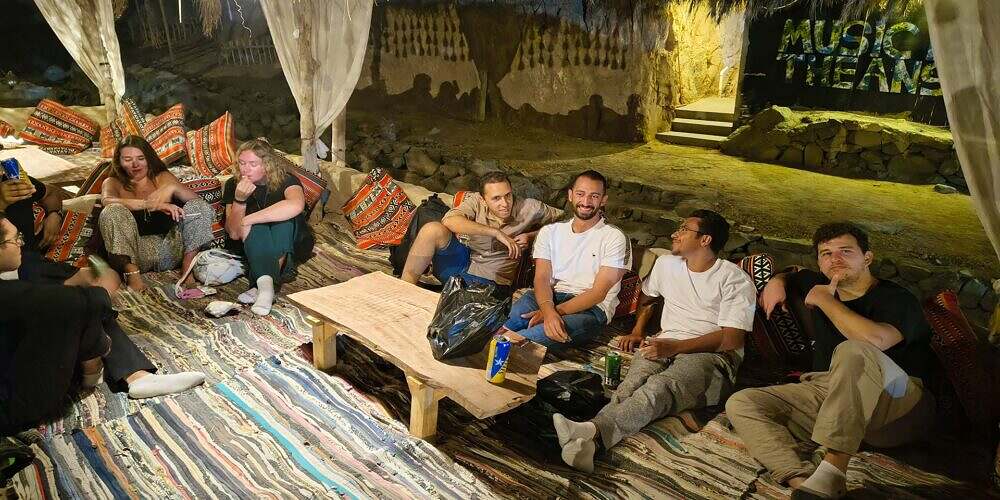
For the first time in many kite trips, nothing was broken or lost. All the doors at the Rafiki Hostel were always open. There were no real lockers. Nothing ever got lost. It was the most colourful and at the same time the quietest and most peaceful of all the 500 hostels I have visited worldwide. Rafiki Oasis was full of interesting people and glowing stories. Everyone let everyone be who they are. I am grateful that I was able to live in this place.
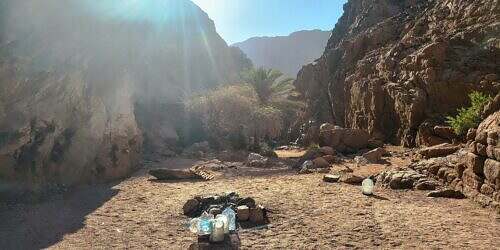
I only left the city limits of Dahab three times in a month. As small as the town is, the freedom it offers is huge. Dahab is supposedly located in South Sinai. But it feels more like a mixture of the wild West and the socialist East: a unique mix in the world. What remains after a month in Dahab? I take home the sound of the waves and the wind in my ears. Everything is quiet. Salam Dahab! Shokran and see you soon to all my dear friends!
 Frank Woelky, born in 1973. Kitesurfer since 1998. Since 2006, I have been combining kitesurfing and web design on trips lasting several months off the beaten track.