

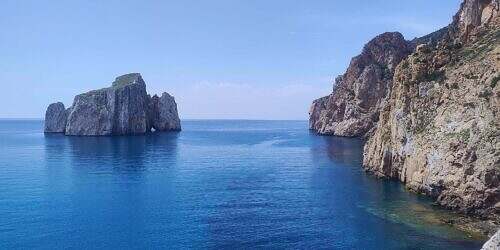
The day before yesterday, the Sardinian wind showed its teeth for the first time on the west coast in the UNESCO World Heritage Site of the millennia-old mines of Sulcis Iglesiente. It was blowing full offshore at 15 to 30 knots, gusting west of Iglesias over the old silver mountains and steep cliffs with mine ruins reaching down to the water. My breakfast baguette flies for a swim.
The coastal road to the north leads over breathtaking rollercoasters on steep slopes through old mining towns such as Nébida. The stub roads into the mines above Buggeru are completely unsecured and therefore offer sweeping views. On the motorway, the Sardinians really do slow down every farting hobo at 30 km/h – but if you need a jeep and blinkers to get up a mountain, there’s definitely nothing at the bottom.
The route continues along narrow hairpin bends to the Punic/Roman temple ruins of Antes. You can still see traces of the Roman labourers in the limestone quarry uphill. A 2,000-year-old footpath leads to the Grotta su Mannau. From the temple, an unsurfaced mountain road leads through a deep gorge 15 kilometres into the highlands to the old mining town of Arenas. Absolute solitude and clear air – but once again everything is closed off. My last mine on the way out of the silver country to the north also flaunts fences and signs: the EU also paid a million euros for this mine just to close it off. I give up.
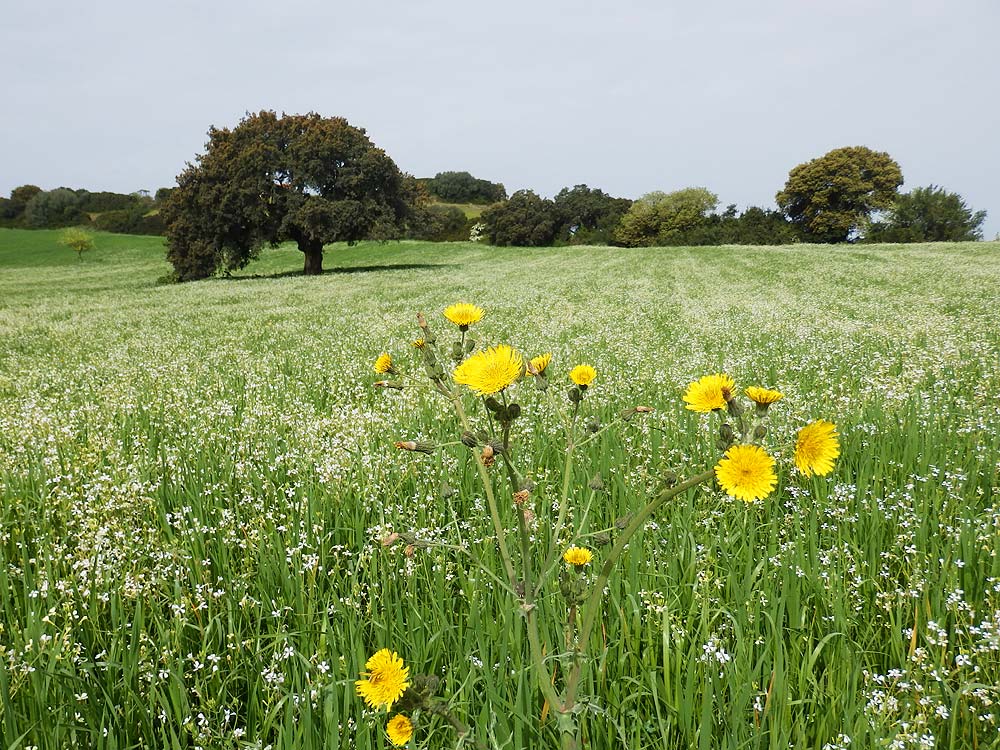
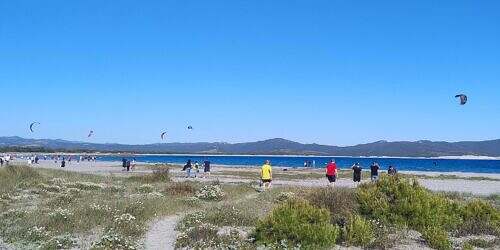
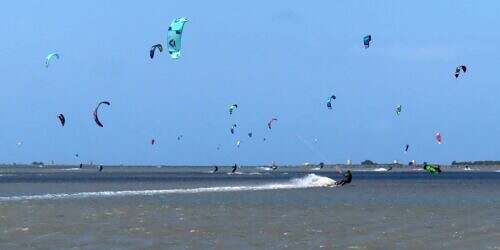
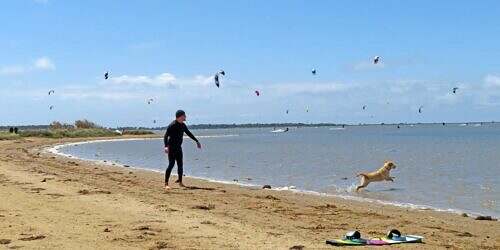
My next stop is Samugheo in the hinterland of Oristano on the west coast. Dark rows of bushes paint labyrinths on the gently rolling hills. White ghost sheep graze between yellow flowering PacMan bushes. Wind turbines point the way to the sea. In Marina Torre Grande, the easterly wind blows nicely sideshore on the wide beach into my 13er, which has obviously been neatly trimmed by Zanzibar. I’m the only kiter, but the virginal Sardinian launch assistants do a good job – and after my first session they grumble about the “Close everything down!” strategy of their home town of Iglesias. As the sun sets, I head back up the hills into the hinterland. I order some wine. Without asking, the landlord places half a litre next to the menu.
Every civilisation once had something to say in Sardinia, and each recycled the produce of the previous one. The Nuragic well sanctuary of Santa Cristina is now the first recycling centre in history. A cantilevered vault in sandstone dating from 1,500 to 1,200 BC leads down 25 steps to an ancient spring. The Romans actually only found hot water cool, so it was the Christians who opened the recycling centre. Today, festivals lasting several days are held twice a year in honour of the local saints, with pilgrims staying in the centuries-old monks’ huts. However, they probably don’t have enough sense of humour for baptisms in the Nuraghic well.
Recycling is an effective way of overcoming fear. We simply recycle our frighteningly large pile of plastic waste, because with a green dot it won’t be incinerated, will it? The Sardinians call their up to 5,500-year-old rock tombs “Domus de Janas”: witches’ houses. In the ancient rock tombs of Sant’Andrea Priu, Stone Age people first carved sacrificial hollows into the rocks of the burial caves, which are up to 250 square metres in size. The Romans thought old-school was cool, painted the walls with frescoes and flavoured the ensemble with fresh corpses. Later, the Christians also added their mustard in the form of more paintings, even more corpses and an architecturally questionable light shaft. The tomb guard is bored by the lack of visitors in the pre-season. She gives me a free tour of the otherwise closed tombs – and then asks me not to dispose of my cigarette butt in the plastic rubbish bin.
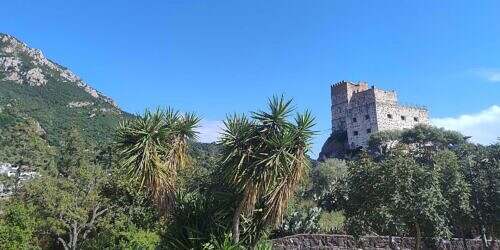
In the old Genoese eagle’s nest castle ruins of Monteleone Rocca-Doria, my little Panda proves its drinking qualities. Thanks to up to 7.5 litres of Super / 100 km and often sparse petrol pumps, I roll into the old coastal town of Alghero on the last drop. Algehero was first a pirate harbour. Doria from Genoa crushed the pirates in the 12th century, Aragon from Catalonia expelled Doria to Monteleone in the 14th century and reinforced the mighty fortifications. The whole town is given a Catalan makeover.
At Capo Caccia, the white cliffs drop 300 metres vertically into the sea. With a Czech hitchhiking couple, I climb to the highest – and then down another half of the 634 steps carved into the vertical rock face towards the Grotta di Neptuno. The landlord at the top is a master of the market economy. If someone conquers the stairs, he will also manage the 20 steps to his terrace. And then he is guaranteed to pay any price for a can of cola. He’s right, and the fortress walls of Alghero’s old town glow in the sunset on the other side of the bay.
On the last day of the Sardinian KulturKeule™, there are several Romanesque cathedrals in the Pisan style from the 12th century along the way. Black basalt and white sandstone paint the religion of chipmunks in green flower meadows. The last Nuragic fortress of Santu Antine is the tallest still standing in the whole of Sardinia at 14 metres. Its huge blocks and its proximity to the main SS131 arterial road make for a top price at the entrance, according to the ashamedly smiling guard. I fly past the castle of Castelsardo to the north coast to Porto Pollo to visit my Brazilian-Bavarian kitesurfing friend Signora Estefania de Galinhos.
The wind blows 5,000 years of culture towards my cerebellum. I am overwhelmed by history. Sardinia has a little bit of everything, with a small gap between 500 and 1,000 A.D. But with more time, I would certainly have found some marvellously decaying evidence from this rather dark age. I expected a lot – and most of it was far exceeded.
After a good six days, I return the car to Olbia airport, 40 kilometres away. Once again, a landlord looks at me in disbelief from the speedometer. I grin. Yes, that’s already 2,000 kilometres! Hey, who says Sardinia isn’t a continent? There is only a bus to Porto Pollo twice a day. The taxi costs €90 – but can only arrive in two hours. The nearby Costa Smeralda with its numerous millionaires seems to be having a bad effect on my new mobility.
I walk from the airport to the centre of Olbia and raise my thumb wherever it fits. Nobody stops. I walk into the harbour. Nobody stops. I walk further north. Nobody stops. After passing 391 cars and walking 8 kilometres, I’m just thinking to myself: “Maybe ‘Olbia’ means ‘fuck you’ in Sardinian” – when a sailor in his van finally stops. A worthy end to a tough road trip. Home at last. Food, wine, writing. Fall into bed happy and dead.
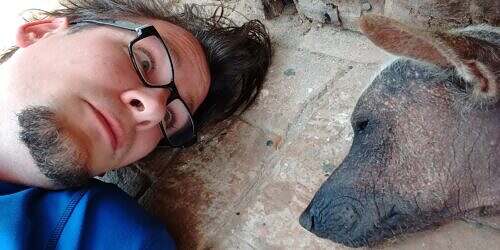
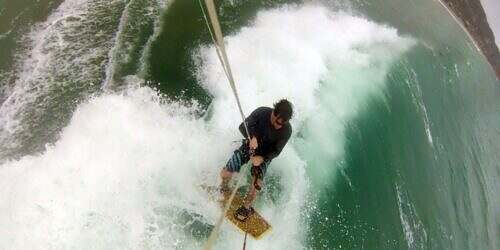
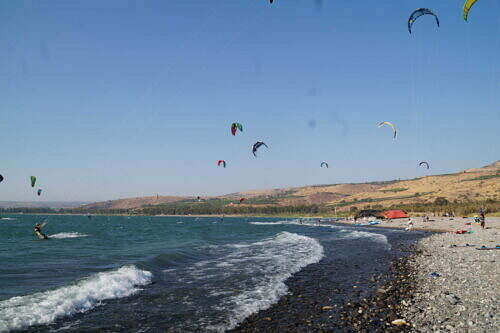
 Frank Woelky, born in 1973. Kitesurfer since 1998. Since 2006, I have been combining kitesurfing and web design on trips lasting several months off the beaten track.