

I have seen a lot. I have experienced a lot. Today I’m just surviving. I’ve never been so scared of death in my life. The third typhoon hits Bulalacao on 25 December with full force and gusts of around 200 km/h. The roof of our emergency shelter is partially torn off. The roof of our emergency shelter is partially torn off. The Day After. Ground zero. Complete destruction.
A few weeks ago, my Liverpool kiter Buddy King George joked that I would be honoured with a third typhoon during my two months in the Philippines. I studied Windy in disbelief until just before Fiji. I found nothing. About a fortnight ago, a cyclone actually formed. First it was a tropical storm, then it became a typhoon. It hit Bulalacao with a category four out of five, making it the strongest typhoon in 50 years.
We studied the forecasts several times a day for weeks. At first, it looked as if the typhoon would lose some of its energy through the islands in the east of the Philippines and move northwards over Mindoro. But the forecast changes. Typhoon Ursula gained more energy over the Visayas. For us, however, the most devastating detail was that it shifted its course to the south. It passes very quickly and compactly right between Boracay and southern Mindoro. This meant that the windier northern side of the typhoon hit us with full force from the open sea in the east.
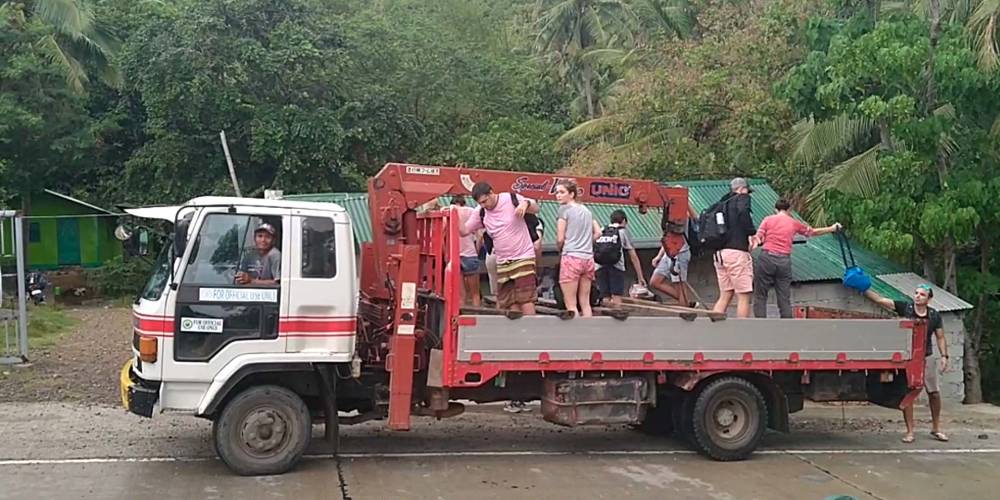
On Christmas Day, Kathrin wakes all the kite camp guests before six o’clock after a short night. The sturdy safari tents are hastily dismantled. Beds and mattresses are stacked in the concrete sanitary blocks. With a proper Christmas Eve hangover, we walk up the mountain to the main road and are evacuated on the back of a lorry through a light drizzle to the supposed safety of Bulalacao. The jungle is dead quiet.
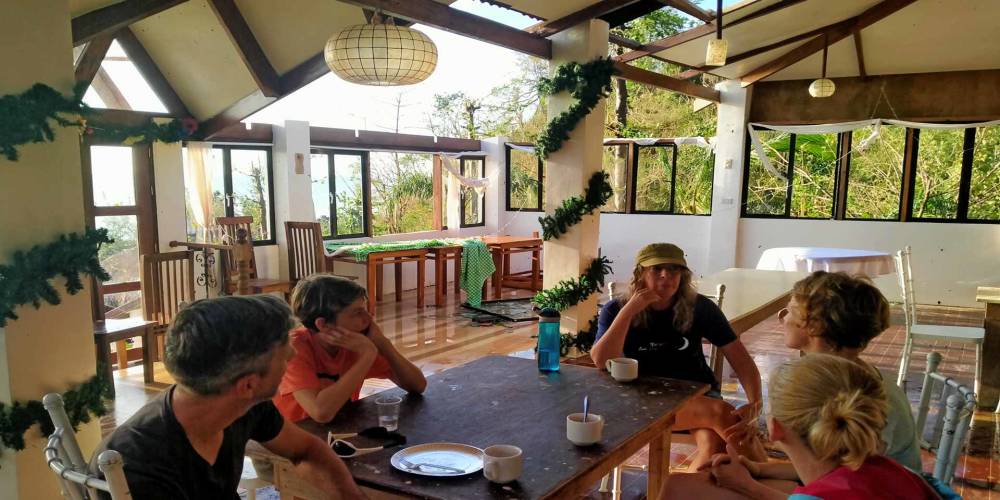
At first I wonder why we are travelling to the wooden restaurant of the South Drive Beach Resort. Facing the dangerous east, it stands on a large glassed-in hill directly above the exposed bay of Bulalacao. But the forecast was better again in the morning. The typhoon was expected to hit us with only 150 km/h. Unfortunately, the forecast was wrong. Even the steel By The Sea Hotel suffered massive damage from the devastating 200 km/h typhoon impact.
Chronicle of the typhoon in Bulalacao 25.12.19
8.00 hrs. All 20 kite camp guests and five other stranded travellers settle into the wooden dining room of the South Drive Resort. Playing cards. Reading. Writing. Listening to music. Sleeping it off. Playing table tennis. Inspecting the rafters, battens and construction method.
10.00 o’clock. The wind picks up. Palm fronds shake in the still relatively mild rain. In the east, everything is getting dark under mighty clouds. First videos and pictures are taken.
11.00 o’clock. Our emergency shelter serves us a good lunch. There are fewer conversations. Nobody sleeps any more and the table tennis balls fall silent. The wind is getting stronger. Palm trees bend in the wind, which initially comes from the north at around 110 kilometres per hour. Torrential downpours hit the unprotected all-round glazing. Small branches break and fly away. Thick bamboo bushes are bent low.
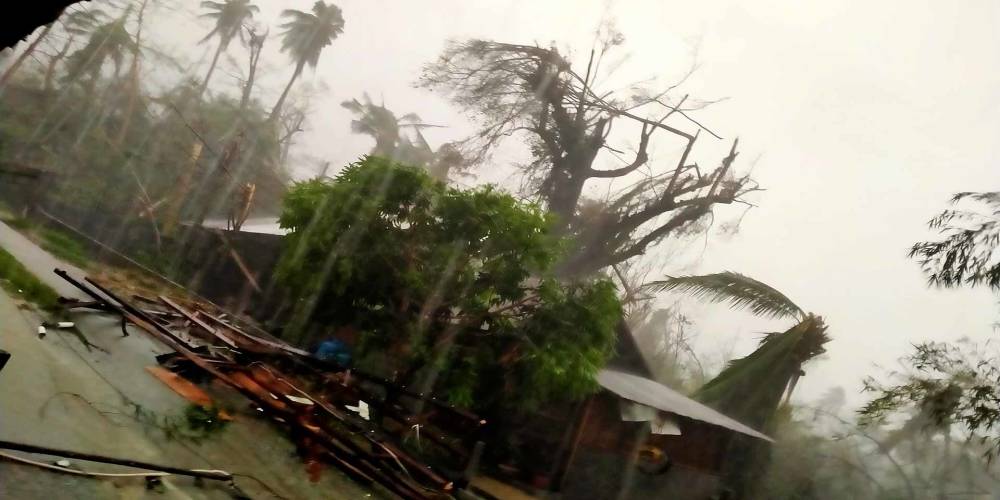
12.00 o’clock. The heavy rain blocks a drain at the side of the resort. A small river of mud and water pours through the back door of the restaurant and flows out through the patio door at the front. The gaps between the rattling hinged doors become wider and wider in the storm, which is now travelling at around 150 km/h. The first trees break right next to the resort. The first trees fall right next to the resort and smash a fence. An initially small gap between the eaves and the wooden roof seems to breathe menacingly with every gust.
13.00 o’clock. The typhoon increases to around 175 km/h from the east. The sea is boiling. We can barely see it in the heavy rain. Palm trees are torn apart. Leaves and branches smash against the windows. We move back. An old 20 metre high tree behind the resort is shredded and collapses with a loud crash. 10 cm thick bamboo canes break in front of the entrance in apocalyptic gusts. Hardly anyone is still filming. Hardly anyone is still talking. The faces become more and more worried. The first window cracks. We erect barricades of tables and chairs.
14.00 o’clock. Despite the barricade, the door to the east keeps breaking open in what is now a 200 km/h wind. We push it shut again several times. The owner’s previous shamanic spirit soothing with brooms on tables doesn’t seem to work. Then the first window shatters. Everyone screams in panic. Rain whips painfully into their faces.
We duck into the furthest corner of the toilets at the back. The pressure of the typhoon almost bursts our ears. Outside, the world is ending. And it keeps coming in. More windows shatter. Nobody is filming any more. It crashes, thunders and rumbles with elemental force. Then a quarter of the roof is torn from its moorings and flies away.
Panic breaks out. Cries of fear. I pray for the first time in 20 years. The cook rattles the cutlery in the sink to appease me and makes me even more nervous. How am I supposed to hear when the roof finally comes off? We’re all sitting under the same roof. It reaches from the hole in the front to us over the toilets and the kitchen. Children cry crouched under the massive concrete tables. I’m scared to death. I feel sick with fear. My feet, hands and cheeks tingle for a good hour as if I’m on the verge of blacking out while breathing under pressure.
If the roof lifts off completely, the only way out is the hut on the other side of the courtyard. In between lies a quarter of a roof truss under hanging power lines. 200 km/h sweep over it. Safety is so close – and infinitely far away. If we have to go over there in this wind, there are guaranteed to be casualties or even fatalities. But the roof holds. For a whole hour.
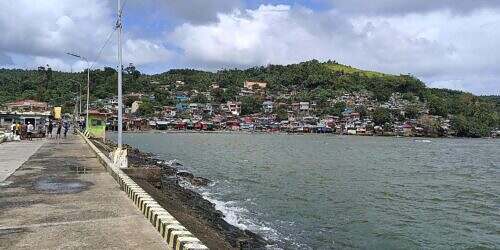
15.00 o’clock. The typhoon slowly subsides. Everyone takes a deep breath. Rain splashes through the hole in the roof onto our faces. Everyone is happy to still be alive. No one trusts the peace. But it holds. A trembling, damp cigarette. The wind turns south. It means that we have reached the back of the typhoon. An incredible downpour begins. The sea boils in waves of over three metres. Torrents feed them with thick branches. The 50-metre-long FastCat ferry breaks away from the harbour. It doesn’t sink as first reported – but it does run aground. The only connection to Boracay will remain interrupted for a long time.
16.30 o’clock. Some friends had barricaded themselves in the resort’s small bungalows. They all come back slowly. Had made the better choice. Trees fell on some of the bungalows and the roof leaked – or the air conditioning was ripped out of the wall. But the mattresses and beds in front of the windows kept the fear further out than in the restaurant. Nobody was injured. Everyone survived.
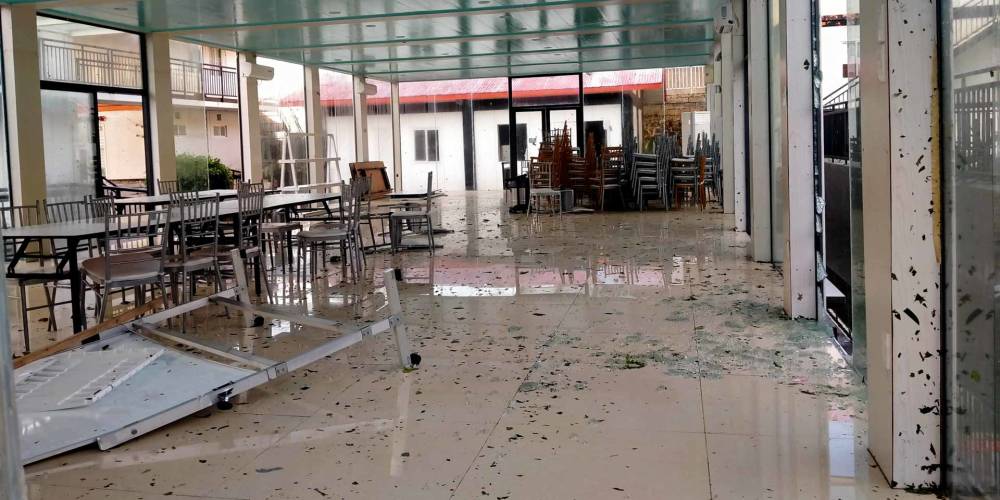
17.00 o’clock. With a German couple, I decide to flee in the weakening rain to the nearby steel-built Hotel By The Sea. It takes us almost half an hour to walk the 800 metres through knee-deep mud, torrents and under fallen giant trees with torn power lines. The By The Sea was also badly hit. A good part of the roof is missing. Massive sections of the steel façade were torn off. Window panes are shattered.
Soaking wet and almost out of money, we arrive at the candle-lit restaurant. London expat Greg and his Filipino wife buy us dinner and beer. The hotel gives us free shelter in a dry bed. Thank you all so much! There is no water, electricity or telephone. We hit the sack early, exhausted.
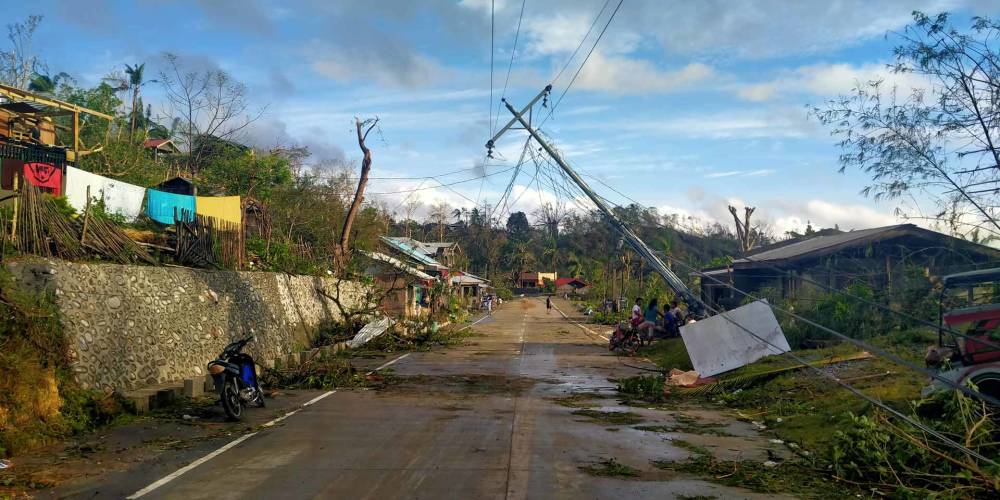
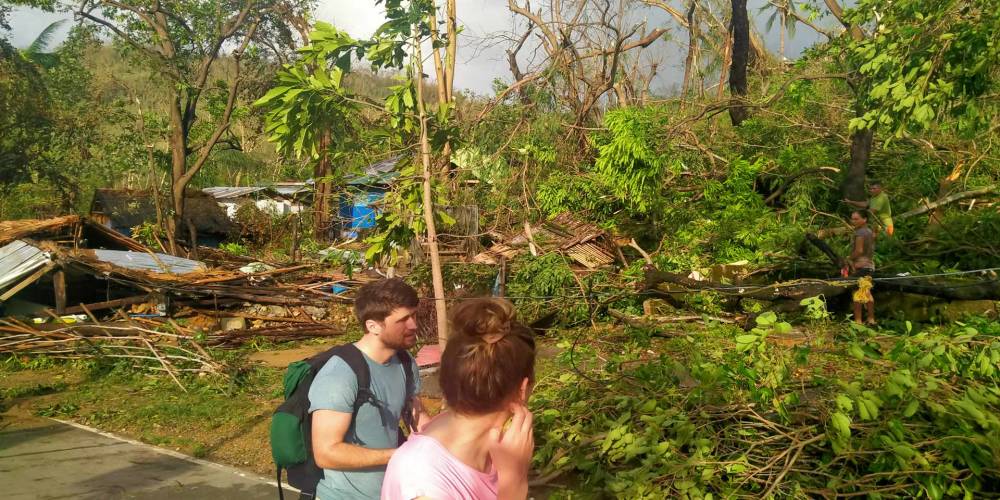
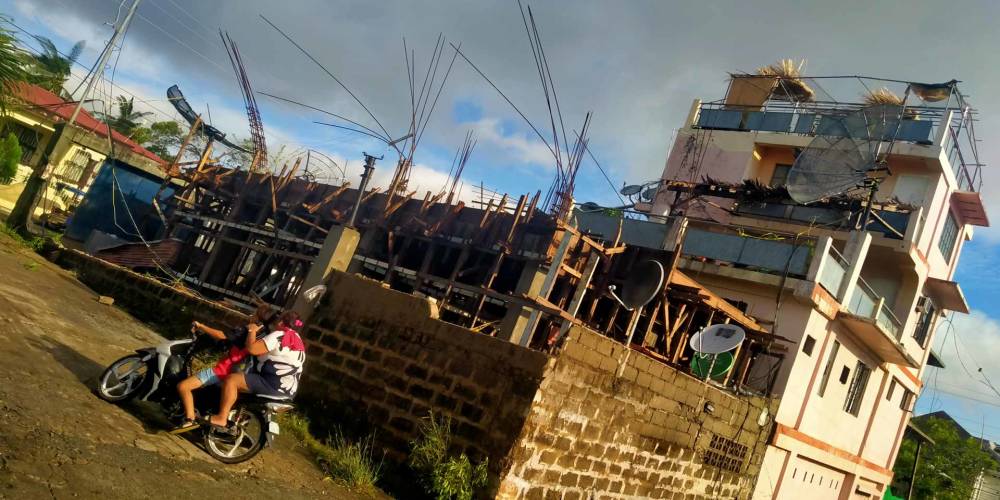
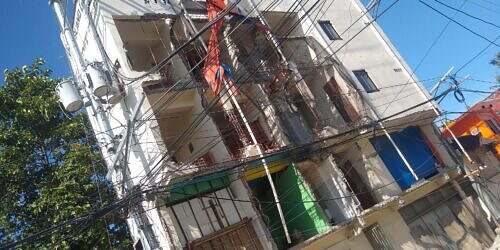
The next morning there is no wind at all. Not a leaf is stirring. There are hardly any leaves left either. At least not on the trees. Hardly a tree is left standing. Everything has been blown away. Like a volcanic eruption. Half of all the houses are badly damaged or completely destroyed. At the cemetery, the houses of the dead are upside down. Fallen giant trees and power lines block the road every few metres. Ground zero. The Day After.
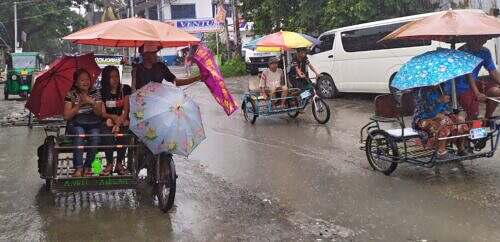
A Filipino smiles sadly at me as I walk past the rest of his house. He has little left to collect. After a while we find a trike. The German doctors want to help at the hospital. But as it turns out later, the worst affected areas are a little to the south and on the islands off the bay. The victims are not yet able to get through from there. I ask our driver how his family is doing. He starts to cry. Some people have died – many more than in the last “big” typhoon Tisoy.
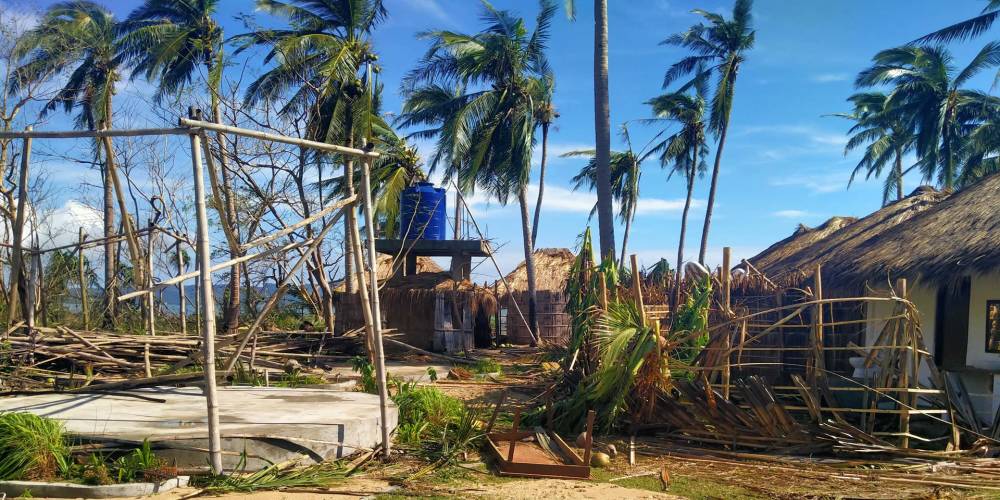
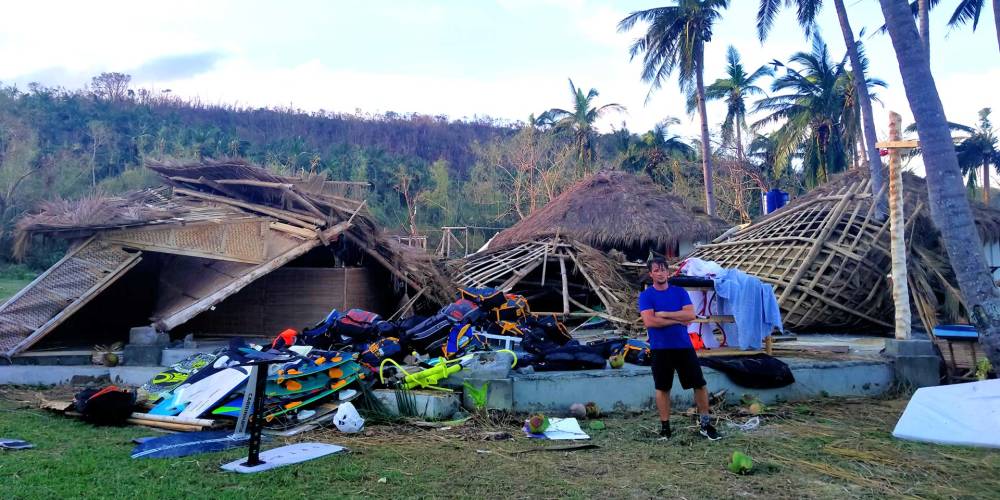
Employees of the kite camp collect us on the main road on motorbikes. The side road to the kite camp is partially or completely blocked by 67 trees. Plus hundreds of palm trees and bamboo bushes. Bamboo scaffolding is used to build skyscrapers in Asia. Nothing is being built here. Everything has been destroyed. The worst destruction is on the last exposed hills in front of the kite camp. The Mangian bamboo huts have been atomised. Not a tree is left standing. The panorama resembles a meteorite impact.
I’m really worried. Kathrin wanted to sit out the typhoon with her people in the camp. It was in the front line. Is it possible to have survived there? It ends at the entrance gate to the kite camp. The 700 metre long private road is completely blocked by fallen trees. Large and very aggressive red ants attack our descent in cohorts. Two hornets give me the last of their lifeblood.
Kathrin and the whole crew are standing among the rubble of the completely destroyed kite camp. Nobody is injured. Everyone is alive – except for two goats. The mountains around the bay form a veritable typhoon caldron. The winds came from all directions. The crew survived in the last bathroom at the very back of the concrete sanitary block. The walls of this and the bungalows, along with the concrete yoga pagoda, are the only things left standing. Everything else has been destroyed: Roofs, doors, windows, walls, huts, benches and the scaffolding of the safari tents.
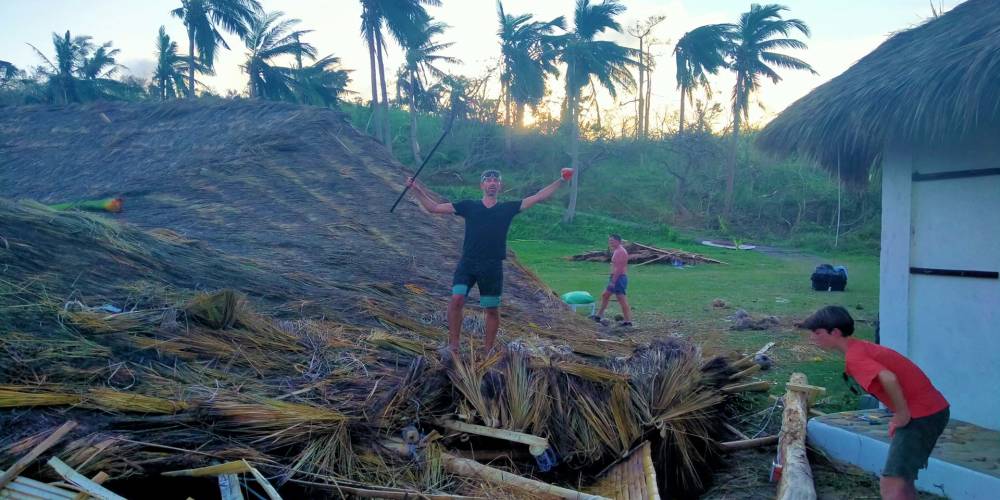
The worst hit was the 15 metre restaurant pagoda. Despite its sturdy construction of bamboo and 20 cm thick posts, it was completely destroyed and collapsed. Buried underneath is the centre of the kite camp with kitchen, drinks, food, tables and chairs. Kathrin stands in front of the remains and plans the reconstruction with a grin.
The dangers of ground zero become apparent as soon as she arrives. The doctor from Kiel immediately rams a long rusty nail deep into her foot. There are hundreds of bamboo sticks with such nail traps all over the ground. The first thing we do is clean the whole area. Nevertheless, a few more helpers get caught in the course of the clean-up. My thick soles save me several times from massive blood loss.
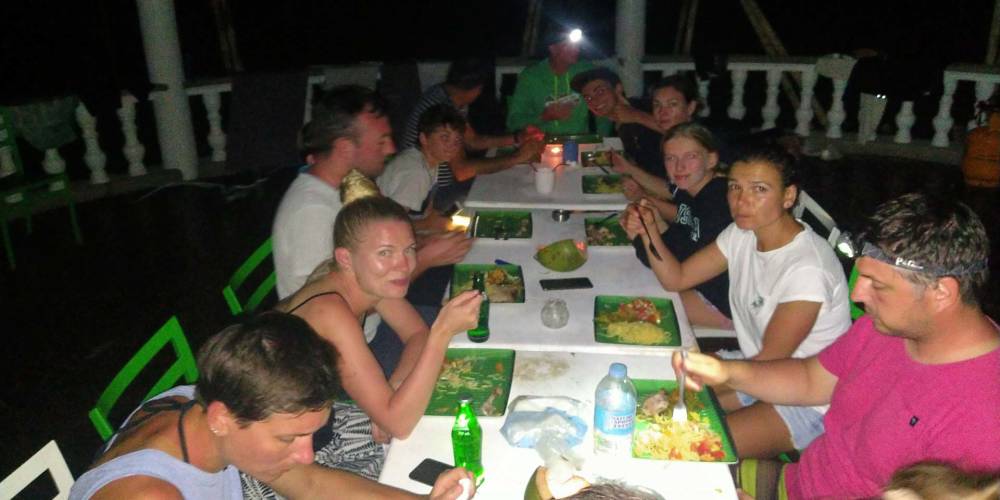
We remove the rubble from the yoga pagoda. We set up a makeshift restaurant and kitchen with the remaining tables and chairs. All the water and food has to be brought in on foot over long distances due to the blocked road. 25 litre canisters reach us on completely exhausted shoulders. There is no running water, electricity or telephone.
Other helpers from the evacuated crew arrive and immediately help to clear the bungalows of shattered glass and rubble. Another group takes care of the rubble on the safari campsites. We dry the tents, mattresses and beds. By the evening, four safari tents are up again.
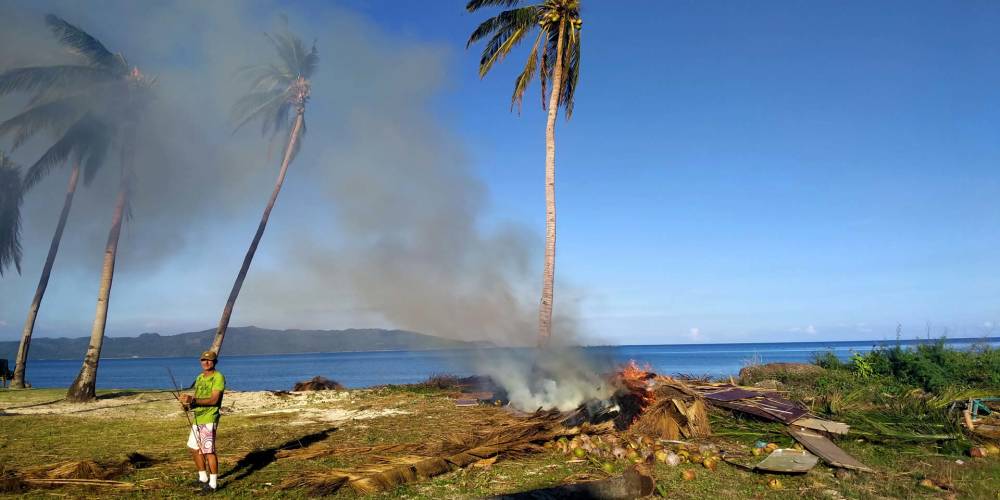
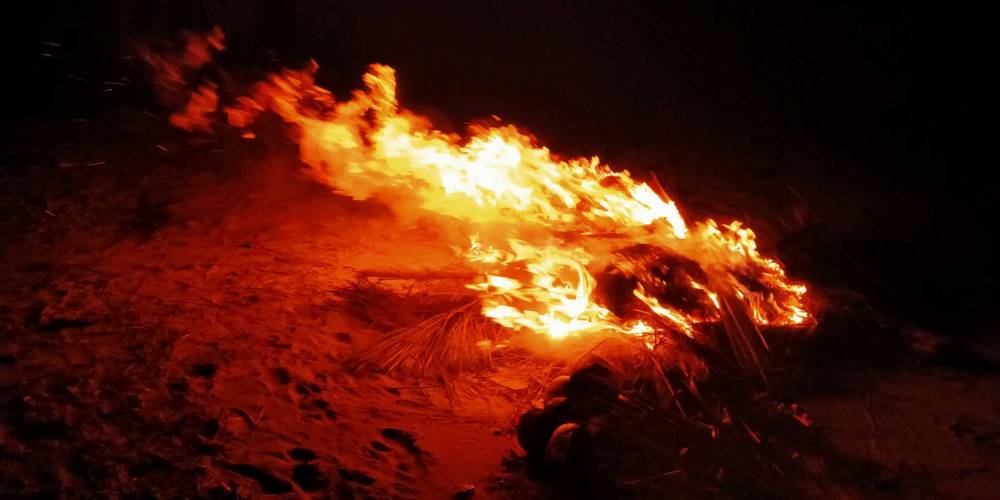
Most of the work involves removing the huge restaurant pagoda. The dangerous rubble is full of nails. They are placed on huge pyres which are set alight on the second evening. Within two days, we manage to demolish almost half of the restaurant. Then, in the tropical heat and complete absence of wind, seven litres of water vaporised through the skin alone during the day, our strength wears off.
Kathrin collapses completely exhausted in the middle of the restaurant after bringing food for everyone on the first evening – and doesn’t get up again until the next morning. We destroy the last of our alcohol supplies. Mosquitoes attack me all night long. Cabrinha, the huge and rather rabid pet pig, finds my odour quite enchanting. She pays me several visits every night in the pagoda and tent. The goats are also difficult to scare away from the kitchen.
On the second day, in the absence of axes and chainsaws, we chop the 700 metre path to the main road clear of tree trunks up to 20 cm thick with machetes. The sun stings almost as much as a few dozen bites from red ants. During a short refuelling stop at the restaurant, I suddenly feel like I’ve had enough. It was too much. My feet, hands and face don’t want to stop tingling for an hour while lying down, despite the massive amounts of sugar and salt water.
In the evening, under a clear starry sky, we burn the remains of the restaurant roof in a large bonfire on the beach to “Ring Of Fire”. Everything is infinitely quiet. Everyone is over. Everyone helped where they could. Good people.
After two days of hard work and seawater washes, I make my way home. Six hours by bus to Calapan. The first freshwater shower in four days is priceless. The first news arrives again. The kite camp’s fresh water pump is working again. 40 workers will soon start rebuilding the kite camp. Relieved by the good news, my suitcase loses its bike on the last day of the trip. Buying a replacement. Eat. Collect. Processing. Writing. Resting.
The next day we take the ferry over to Batangas and a bus through the madness around Manila to the airport. It was a tough journey. But a valuable one.
Please help Kathrin finance the reconstruction!
Book your place in kitesurfing paradise:
www.kitesurf-mindoro.com.
Everything should be up and running again from mid-January.
I will be back on 7.12.2020.
Philippines, December 2019

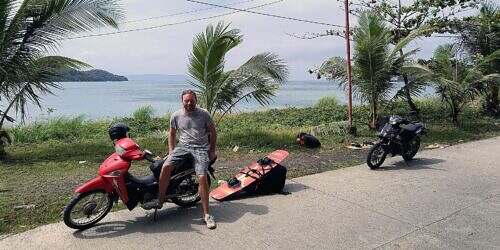
 Frank Woelky, born in 1973. Kitesurfer since 1998. Since 2006, I have been combining kitesurfing and web design on trips lasting several months off the beaten track.