

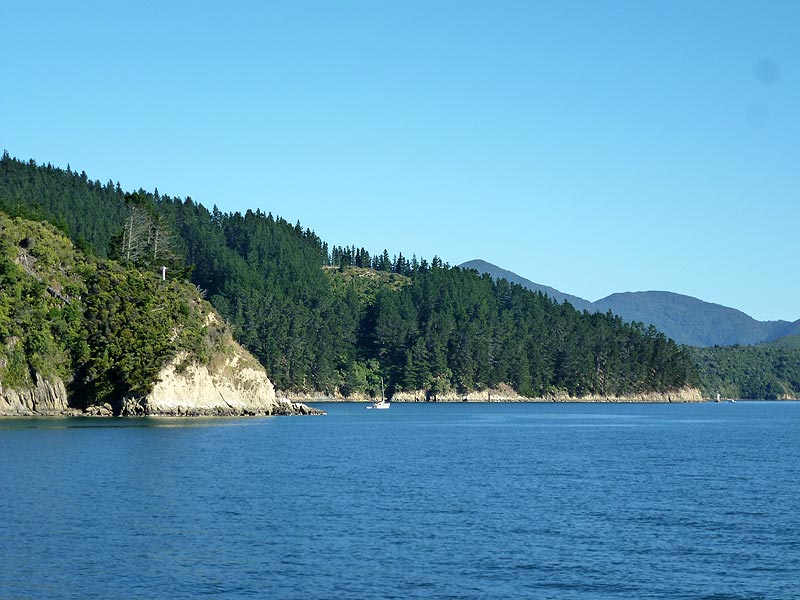
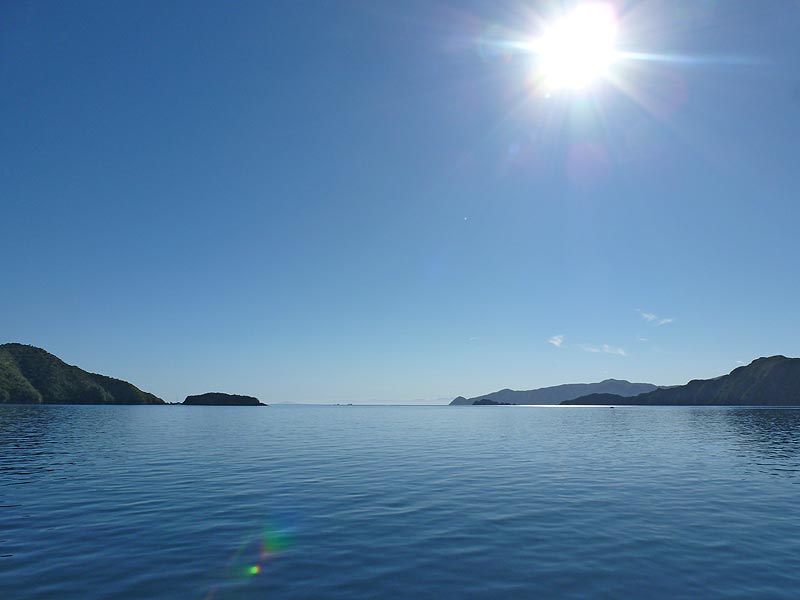
The Marlborough Sounds are located in the north of New Zealand’s South Island. Here, land and sea merge seamlessly into one another: At first, the land predominates with its steep green forested mountains. Then the inlets become wider and bluer. Schools of dolphins hunt, splashing loudly off the last islands in the Cook Straight. Then there is only the sea.
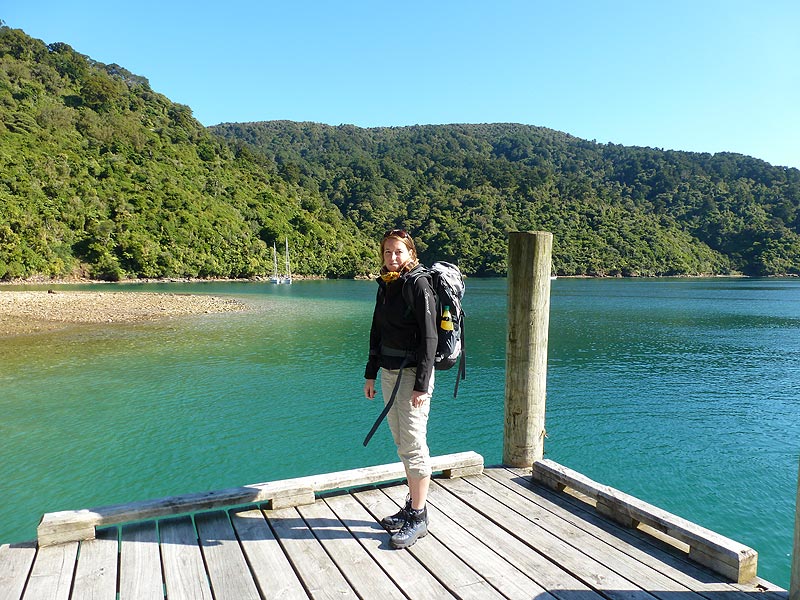
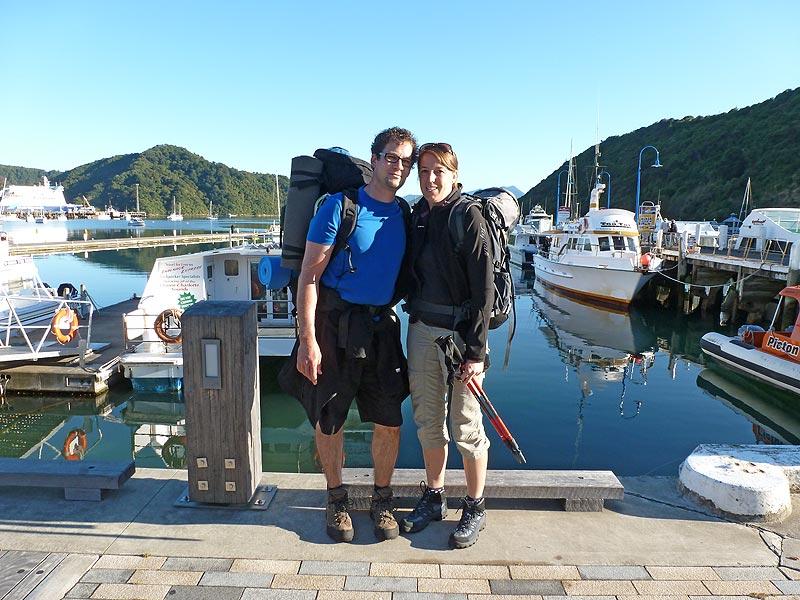
The water taxi drops us off on historic ground. Ship Cove lies quite far out in the sounds. Captain Cook camped here for many weeks on several voyages from 1774. The Maoris also regarded the site as an important stop on their crossing of the dangerous strait. For us today, Ship Cove is the start of the longest hike we have both ever done.
The Queen Charlotte Track is one of New Zealand’s most famous hiking trails. It follows the Marlborough Sounds along endless bays and over numerous steep mountains on the way back from the sea to land. Our four-day hike on the Queen Charlotte Track covers the full 80 kilometres from Ship Cove to Anakiwa.
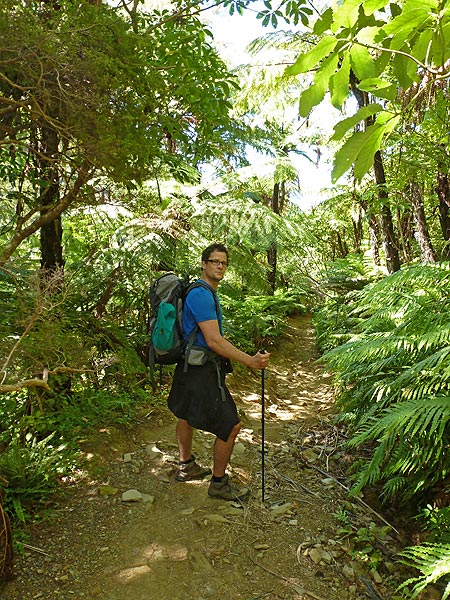
There is some luxury accommodation and campsites along the way, but no DOC huts. We therefore have to take all our camping equipment with us. On the first day of the Queen Charlotte Track, this is still manageable, as the water taxi delivers one of our heavy rucksacks to the first campsite. However, some of the campsites for the next few days are located in the middle of the ridge between the sounds at an altitude of up to 400 metres. The only option here is to carry all our equipment up to the top in a sweat.
A few small settlements further inland on the Queen Charlotte Track can be reached via gravel tracks. But most of them can only be reached by boat. There is not a single shop on the entire Queen Charlotte Track – and even in the terminus of Anakiwa, which is more than just a small village. Our rucksacks also contain enough food for the full four days.
A few weeks ago, we were still smiling about a Franconian extremist whose tent cost more than my laptop and weighed less than a tetrapack. He proudly showed us his magnesium-anodised aluminium pegs, which cost €4.50 each. His face looked a bit like Gollum’s. Our extremism lies elsewhere, which is why our tent only cost €60, but weighed a hefty five kilograms. Even with a mini gas cooker, dry food, muesli and powdered milk, our rucksacks weighed around 18kg on the descent to the start of the Queen Charlotte Track.
The sun is shining at Ship Cove. Even now, in high season, only a few guests get out for more than ten minutes. A considerable mountain of food piles up next to the gigantic rucksacks of two young Frenchmen. Apparently it was the right thing to do after all, even mucking out the reel of my fishing rod. We set off on our way.
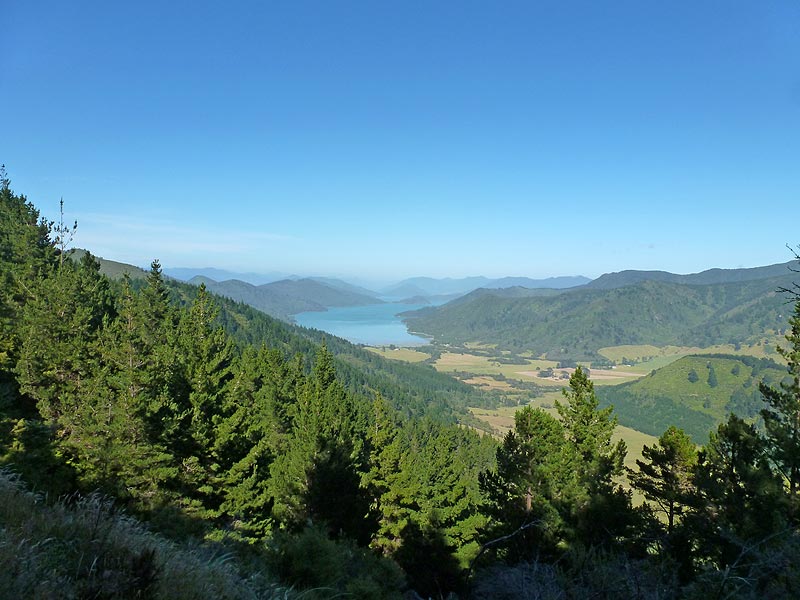
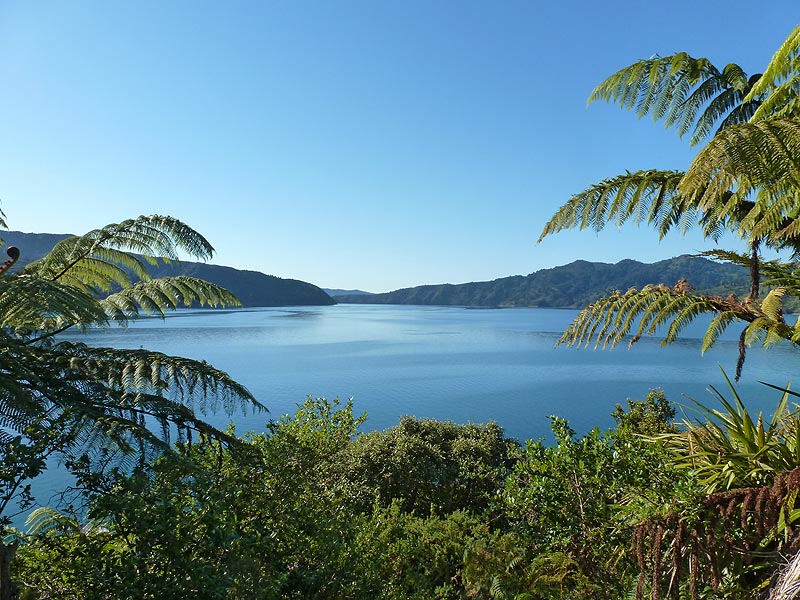
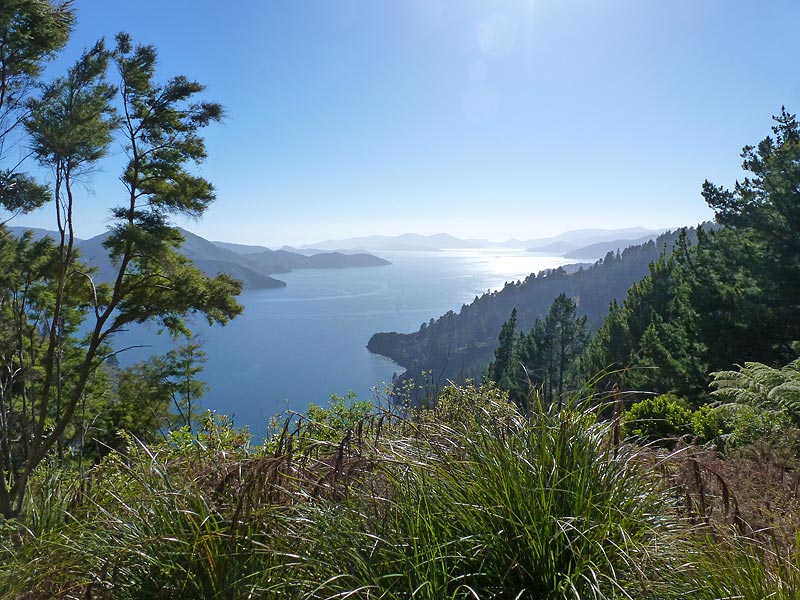
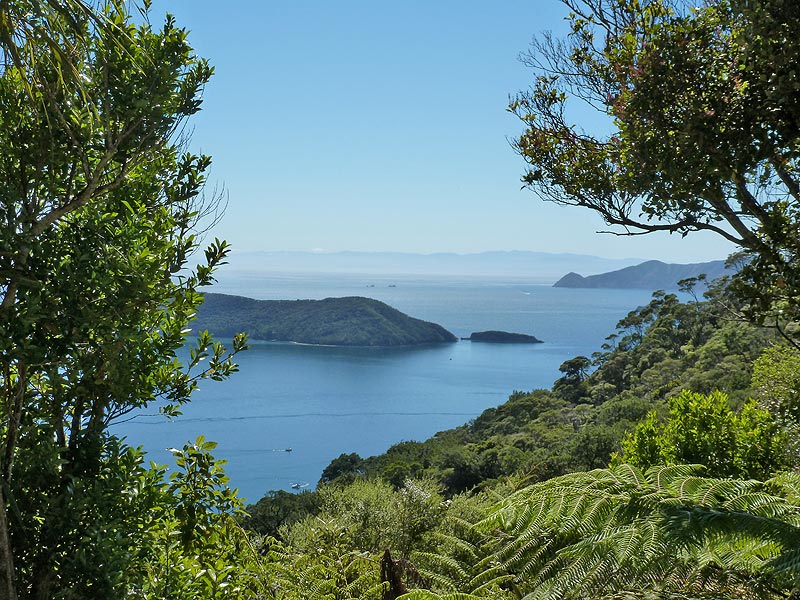
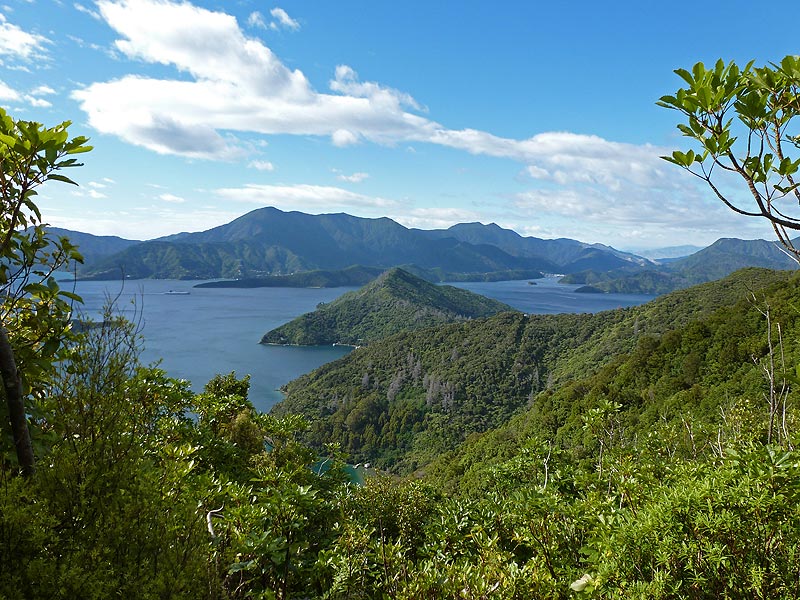
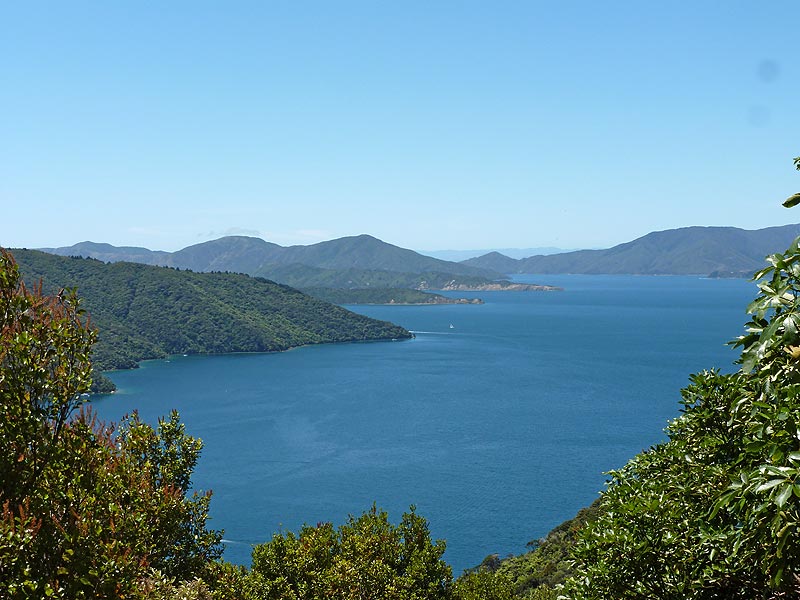
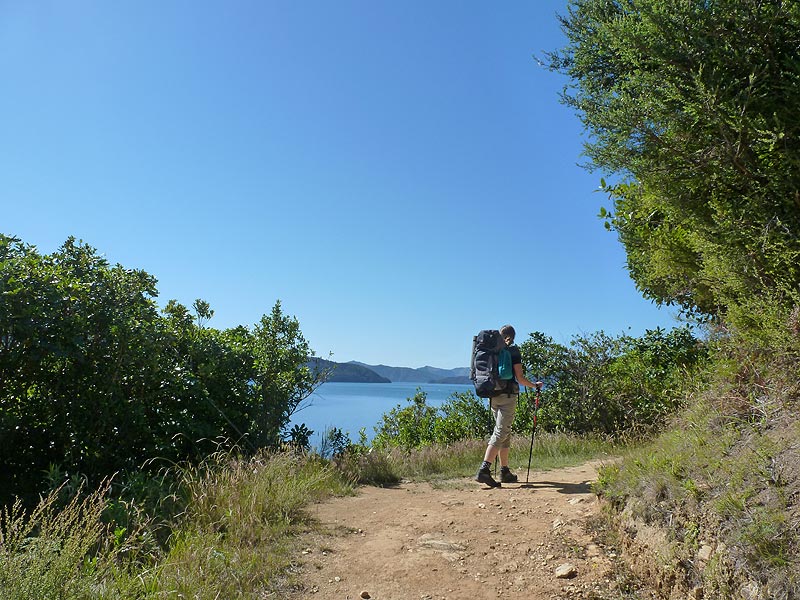
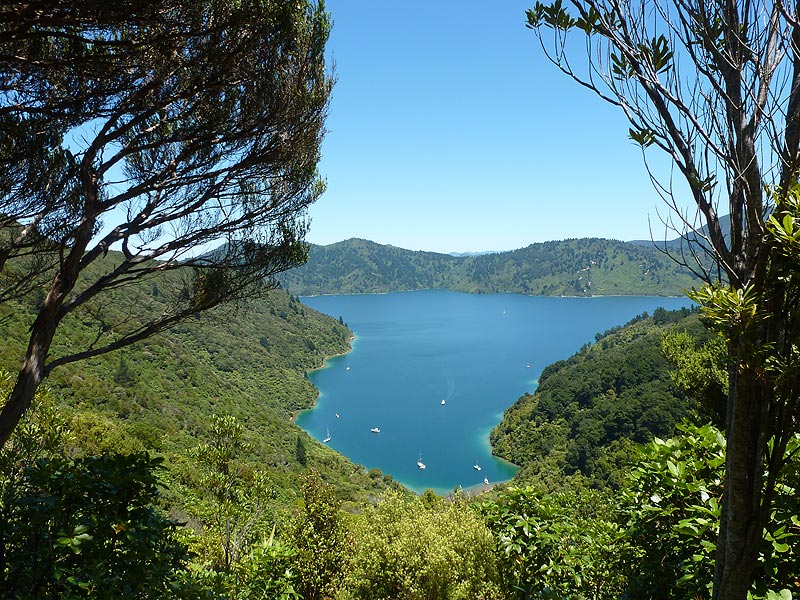
At first, the Queen Charlotte Track climbs steeply into the green jungle. Just as we are wondering why the Queen Charlotte Track is so famous for its views, after an hour we reach the first viewing platform on a saddle between two sounds. Okay, it’s immediately obvious: green trees in front, turquoise to ultramarine blue water below. Behind it is the next steep arm of land covered in green forest. Above it a bright blue sky. In short: green blue green blue. Although the views will always be the same for the next 80 kilometres, with the exception of the partial addition of another green-blue: Each one hits.
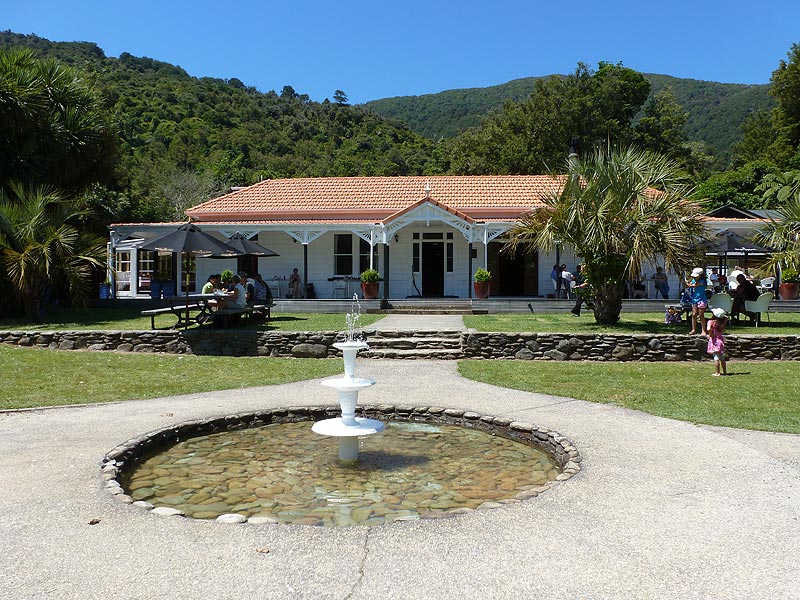
At the head of Endeavour Inlet lies the luxurious Furneaux Lodge. After a good 20 kilometres of wilderness, we’re more than ready for a cool ginger beer and a beautifully expensive falafel salad. The contrast to the Queen Charlotte Track couldn’t be more dramatic. A fountain splashes between gorse bushes on the finest English lawn. The wood of the bar counter looks as if it has endless stories to tell.
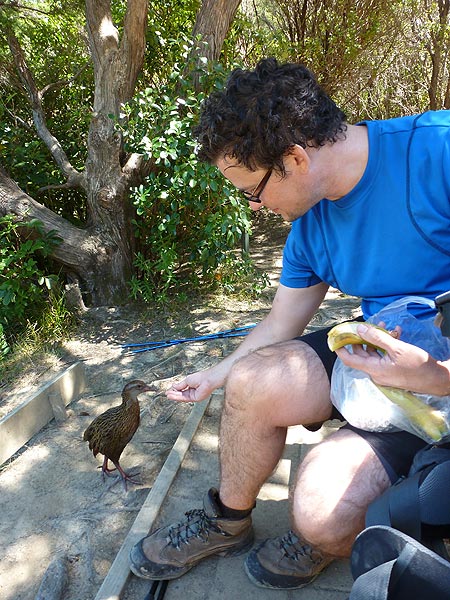
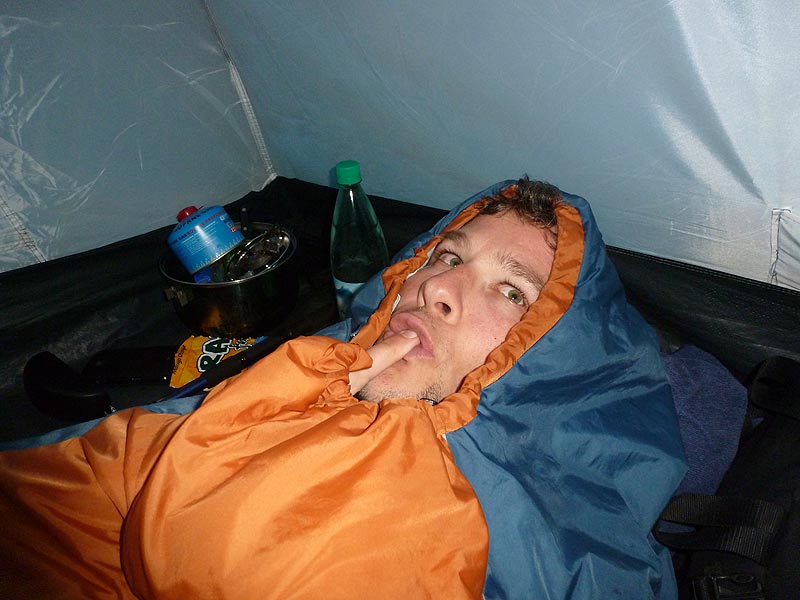
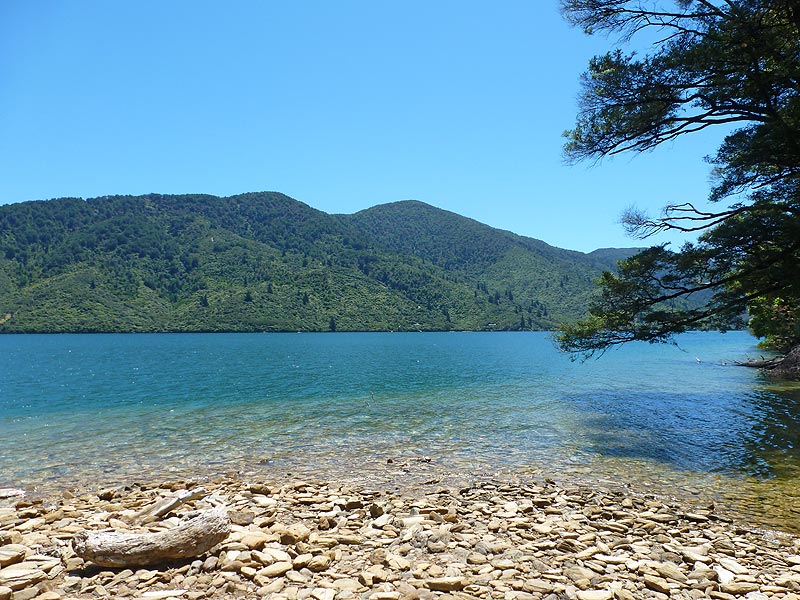
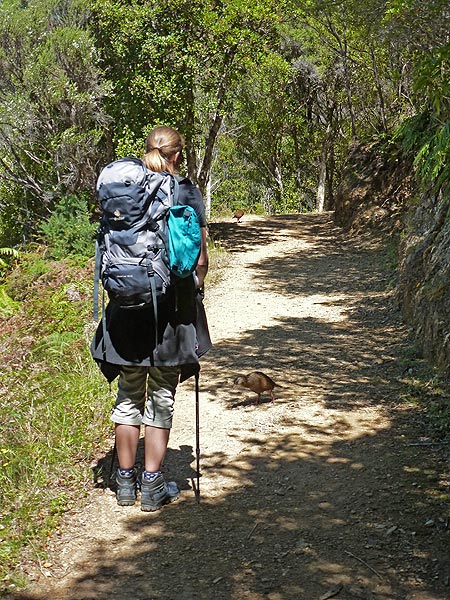
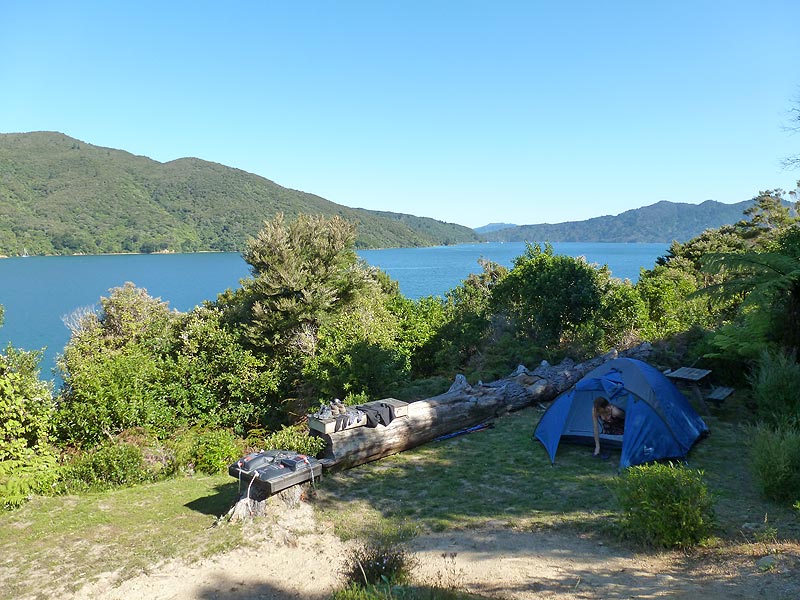
The destination of the first day on the Queen Charlotte Track is Madsen’s Camp. After almost 25 kilometres, I jump into the cold water of the Marlborough Sounds. The French are already lying on the stone beach. Madsen’s Camp is a private campsite with probably the most beautiful open-air solar shower in the world. The view of the sounds is gigantic. I wonder what was here first: the settlement on the other side of the sound or Madsen’s open-air shower? No matter. The French are smoking joints, Weka chickens are stealing tomatoes from an Italian woman, the cookers are quietly sizzling the instant noodles, and we are in our sleeping bags before sunset.
The second day starts very early. We set off before eight o’clock with a full pack, as we are about to tackle the highest ascent of the Queen Charlotte Track, which is almost 600 metres in altitude. Unfortunately, we don’t get very far. Uli had broken his foot the day before. The Queen Charlotte Track is perfect for this, because every few metres you can see what there is to see towards the sea. You don’t always stop for that, otherwise it would take twice as long. But the Queen Charlotte Track is also quite rocky in places.
What didn’t seem too bad at the beginning now prevents Uli from continuing on the Queen Charlotte Track after just seven kilometres. Instead of camping on the next mountain, we only make it as far as Campsite Bay. The last gravel road into the Marlborough Sounds ends nearby. A few fat tourists with sunglasses take the opportunity to go to the loo quickly in the wilderness and then motor back to civilisation. We stay here tonight.
There’s no mobile phone reception, but Uli uses the last public telephone in the Sounds to order a water taxi to take her home tomorrow. Fish’n chips are available next door at the lodge for just $28, so dinner is once again dry noodles. At night, the birds put on an incredible concert from four o’clock onwards. There are no pauses between the various calls, just a single carpet of sound that quickly puts you to sleep.
The cheerful little bird Francesca accompanies me on the next part of the Queen Charlotte track. As we didn’t make it up the mountain the day before, we have to go up and down today. This section of the Queen Charlotte Track is marked on the map as taking eight hours to walk 26 kilometres. Thanks to the altitude, the views expand to green blue green green blue green green green blue. The sun is blazing at 33°.
We meet the two young Frenchmen again at the Bay Of Many Coves Campsite near the highest point of the Queen Charlotte Track. Thanks to their – supposedly excellent Maori grass – permanent stonedness, they have already made it five kilometres today. We overtake them and carry on singing until we reach our next destination for the day in Cowshed Bay. 600 metres up and down show the first effects on our legs. Once we reach the beach, we just fall onto the grass.
Francesca concluded quite correctly: ‘I should really be grateful that Uli twisted her ankle. I’m sorry for her, but the advantages are obvious. After her invalid water taxi full of injured victims of the Queen Charlotte Track, she picks up our car and our food stashed in a hostel in Picton. She also does the shopping. That means an air bed instead of a sleeping mat and fat food instead of dried pasta.
The wind blows quite well at first, but by the time we have pitched the tent, it is too weak again. The panorama would have been amazing, and neither the risk of the trees standing right up to the shore and the power line running directly above them nor a good six hours of hard walking would have stopped me from kiting today. There are fish jumping out of the water everywhere. But the stupid things just don’t realise that they should actually be biting my great new wobbler at the end of the rod. So tuna instead of fresh fish for dinner.
I go alone for the last day on the Queen Charlotte Track. One of the two young Frenchmen also drops out and takes the Uli taxi back to Anakiwa. His feet had become so accustomed to perma-floating that they found the contact with the ground too hard after eating the remaining grass in the morning.
The Queen Charlotte Track climbs steeply again. Clouds are gathering for the first time in four days. This is my final test. I’ve never hiked this far before. The poles are gold today, and it’s almost a scandal how quickly my opinion of hiking poles has changed so drastically from “Depperlsteckerl” to “Vierbeiner”. I approach the land again. The sea arms become thinner, the land arms thicker. A few mountain bikers race towards me.
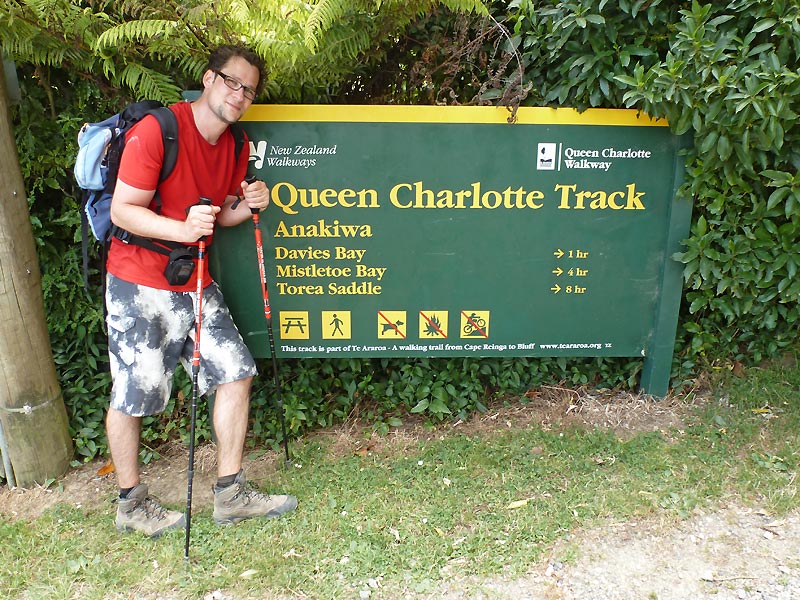
Uli takes all the luggage by car to Anakiwa, the end of the Queen Charlotte Track, a good 21 kilometres away. I hardly have to carry anything, and the anticipation of the imminent end gives me strength. I finally mutate into a marching machine. I only realise how fast I’ve walked the last stage of the Queen Charlotte Track when I arrive in Anakiwa. Instead of eight hours, I reach my destination in four and a half hours. I collapse happily under a palm tree. Uli hands me ginger beer and delicious New Zealand cherries. I must be healthy again.
A soft bed, a big shower and even a hot tub await me at the hostel. No biting sand flies, cannibalistic ducks or carnivorous wild Weka roosters. Great things that bring great joy. The panorama in the bay of Anakiwa is also gigantic. Only the wind is taking the piss out of me again. Hack ultra, carry the kite to the beach, wind gone. A cafe owner next door says I should be happy. The only other local Dutch kiter had broken a rib and got 12 stitches in his scalp the day before yesterday due to the wind. So I’m just happy.




 Frank Woelky, born in 1973. Kitesurfer since 1998. Since 2006, I have been combining kitesurfing and web design on trips lasting several months off the beaten track.